Rein A, Mirro J, Haynes J G, Ernst S M, Nagashima K
Laboratory of Molecular Virology and Carcinogenesis, ABL-Basic Research Program, NCI-Frederick Cancer Research and Development Center, Maryland 21702.
J Virol. 1994 Mar;68(3):1773-81. doi: 10.1128/JVI.68.3.1773-1781.1994.
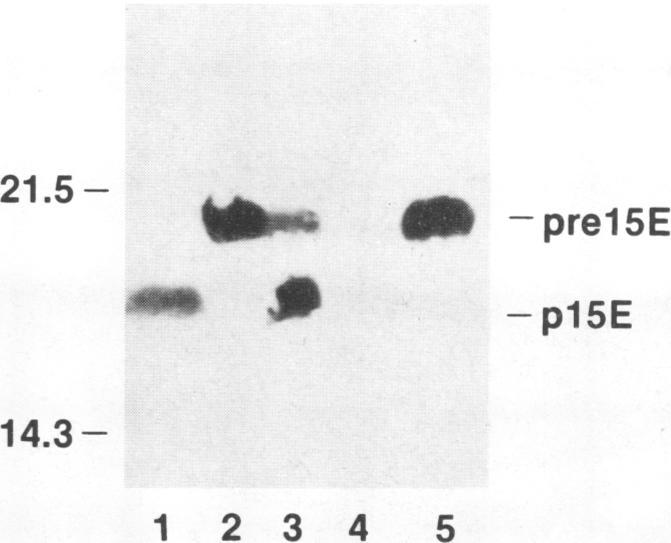
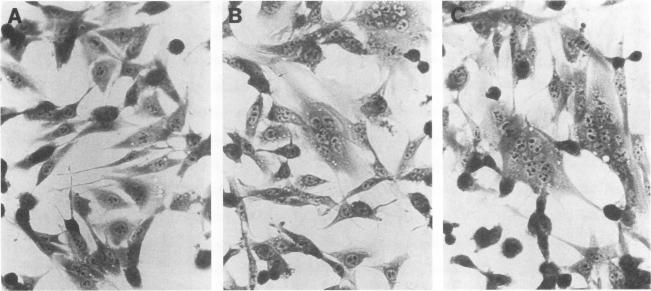
In the murine leukemia viruses (MuLVs), the Env complex is initially cleaved by a cellular protease into gp70SU and pre15ETM. After the virus particle is released from the cell, the C-terminal 16 residues are removed from the cytoplasmic domain of pre15E by the viral protease, yielding the mature p15ETM and p2E. We have investigated the function of this cleavage by generating a Moloney MuLV mutant, termed p2E-, in which the Env coding region terminates at the cleavage site. This mutant synthesizes only the truncated, mature form of TM rather than its extended precursor. When cells expressing this truncated Env protein are cocultivated with NIH 3T3 cells, they induce rapid cell-cell fusion. Thus, the truncated form, which is normally found in virions but not in virus-producing cells, is capable of causing membrane fusion. We conclude that the 16-residue p2E tail inhibits this activity of Env until the virus has left the cell. p2E- virions were found to be infectious, though with a lower specific infectivity than that of the wild type, showing that p2E does not play an essential role in the process of infection. Fusion was also observed with a chimeric p2E- virus in which gp70SU and nearly all of p15ETM are derived from amphotropic, rather than Moloney, MuLV. In a second mutant, an amino acid at the cleavage site was changed. The pre15E protein in this mutant is not cleaved. While the mutant Env complex is incorporated into virions, these particles have a very low specific infectivity. This result suggests that the cleavage event is essential for infectivity, in agreement with the idea that removal of p2E activates the membrane fusion capability of the Env complex.
在鼠白血病病毒(MuLVs)中,Env复合物最初被一种细胞蛋白酶切割成gp70SU和pre15ETM。病毒颗粒从细胞中释放后,病毒蛋白酶从pre15E的细胞质结构域去除C末端的16个残基,产生成熟的p15ETM和p2E。我们通过构建一种莫洛尼MuLV突变体(称为p2E-)来研究这种切割的功能,在该突变体中,Env编码区在切割位点处终止。这种突变体只合成截短的、成熟形式的TM,而不是其延长的前体。当表达这种截短Env蛋白的细胞与NIH 3T3细胞共培养时,它们会诱导快速的细胞 - 细胞融合。因此,通常存在于病毒粒子中但不存在于产生病毒的细胞中的截短形式能够引起膜融合。我们得出结论,16个残基的p2E尾巴抑制Env的这种活性,直到病毒离开细胞。发现p2E-病毒粒子具有感染性,尽管其比野生型具有更低的比感染性,这表明p2E在感染过程中不发挥重要作用。用一种嵌合p2E-病毒也观察到了融合,其中gp70SU和几乎所有的p15ETM都源自嗜异性MuLV,而不是莫洛尼MuLV。在第二个突变体中,切割位点的一个氨基酸发生了变化。该突变体中的pre15E蛋白未被切割。虽然突变的Env复合物被整合到病毒粒子中,但这些粒子具有非常低的比感染性。这一结果表明切割事件对于感染性是必不可少的,这与去除p2E激活Env复合物的膜融合能力的观点一致。