Ragheb J A, Anderson W F
Molecular Hematology Branch, National Heart Lung and Blood Institute, National Institutes of Health, Bethesda, MD 20892.
J Virol. 1994 May;68(5):3220-31. doi: 10.1128/JVI.68.5.3220-3231.1994.
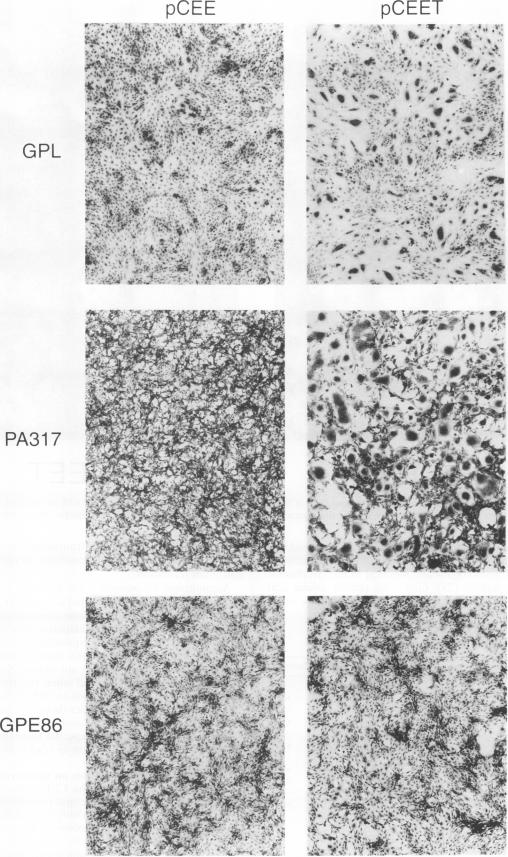
Murine leukemia virus ecotropic and amphotropic envelope expression vectors were genetically engineered to generate truncations of the p15E TM cytoplasmic tail. The ecotropic construct CEET has the entire cytoplasmic tail of TM deleted, while the CEETR construct has only the R peptide portion of the tail deleted, thereby producing a TM subunit (p12E) that is identical to the one found in mature virions. The analogous amphotropic constructs were called CAET and CAETR. These envelopes, as opposed to their p15E TM counterparts, mediate cell-to-cell fusion at neutral pH in both transformed and nontransformed cell lines. Though the TM cytoplasmic domain is not required, its presence appears to augment such cell-to-cell fusion. This envelope-dependent fusion requires the presence of the viral receptor on the cell surface. Ecotropic virions bearing the p12E TM contain wild-type levels of the envelope complex and have near-normal titers. In contrast, virions which lack the cytoplasmic domain of TM (e.g., CEET) have 10- to 100-fold-lower titers but contain normal amounts of envelope. Both of the corresponding amphotropic virions contain normal amounts of envelope but have 10- to 100-fold-lower titers. Using immunofluorescent detection of envelope to monitor the fate of receptor-bound virions, we found that ecotropic murine leukemia virus envelope disappears from the cell surface while amphotropic envelope persists on the cell surface after virus binding. This pattern of immunofluorescence is consistent with the proposed routes of cell entry for these viruses, i.e., by endocytosis and direct fusion, respectively. In this assay, ecotropic virions bearing the genetically engineered p12E TM also appear to be internalized despite the ability of their envelope to mediate fusion at neutral pH in the same target cells. Our results show that direct fusion at neutral pH is a natural consequence of the surface expression of the mature ecotropic envelope and its receptor. We propose that the processing of the R peptide from the envelope TM (p15E) to yield p12E, at the time of virus budding or within virions, renders the envelope competent to fuse.
对鼠白血病病毒亲嗜性和兼嗜性包膜表达载体进行基因工程改造,以产生p15E跨膜(TM)胞质尾的截短形式。亲嗜性构建体CEET删除了TM的整个胞质尾,而CEETR构建体仅删除了尾的R肽部分,从而产生了一个与成熟病毒粒子中发现的TM亚基(p12E)相同的亚基。类似的兼嗜性构建体称为CAET和CAETR。与它们的p15E TM对应物不同,这些包膜在转化和未转化的细胞系中均在中性pH下介导细胞间融合。尽管不需要TM胞质结构域,但其存在似乎增强了这种细胞间融合。这种依赖包膜的融合需要细胞表面存在病毒受体。携带p12E TM的亲嗜性病毒粒子含有野生型水平的包膜复合物,且滴度接近正常。相比之下,缺乏TM胞质结构域的病毒粒子(例如CEET)滴度低10至100倍,但包膜含量正常。两种相应的兼嗜性病毒粒子包膜含量正常,但滴度低10至100倍。利用包膜的免疫荧光检测来监测与受体结合的病毒粒子的命运,我们发现亲嗜性鼠白血病病毒包膜在病毒结合后从细胞表面消失,而兼嗜性包膜则持续存在于细胞表面。这种免疫荧光模式与这些病毒提出的细胞进入途径一致,即分别通过内吞作用和直接融合。在该试验中,携带基因工程改造的p12E TM的亲嗜性病毒粒子似乎也被内化,尽管其包膜能够在相同靶细胞的中性pH下介导融合。我们的结果表明,在中性pH下的直接融合是成熟亲嗜性包膜及其受体表面表达的自然结果。我们提出,在病毒出芽时或病毒粒子内,将包膜TM(p15E)中的R肽加工成p12E,使包膜具有融合能力。