Pachuk C J, Yoon K, Moelling K, Coney L R
Department of Molecular and Cellular Biology, Apollon, Malvern, PA 19355.
Nucleic Acids Res. 1994 Feb 11;22(3):301-7. doi: 10.1093/nar/22.3.301.
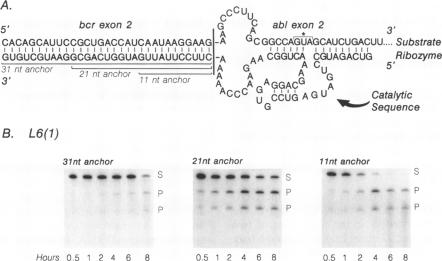
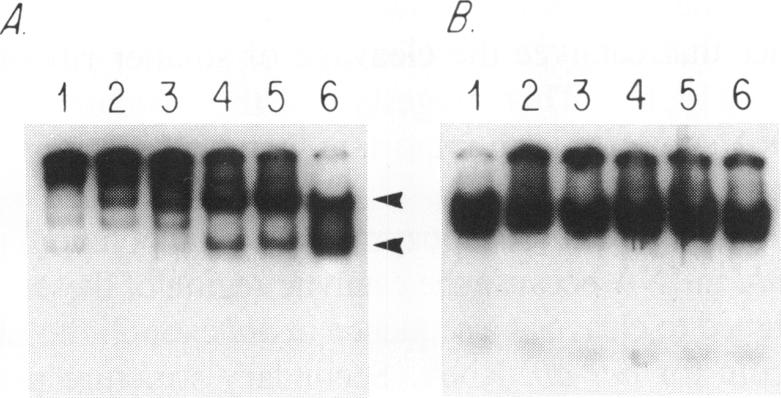
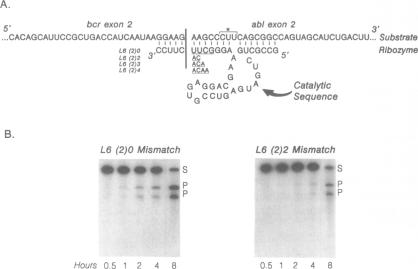
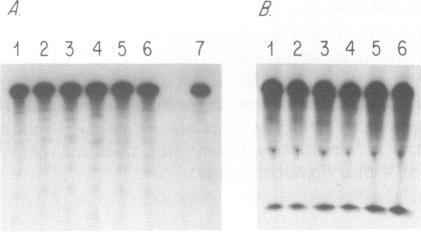
Conventionally designed ribozymes may be unable to cleave RNA at sites which are inaccessible due to secondary structure. In addition, it may also be difficult to specifically target a conventionally designed ribozyme to some chimeric RNA molecules. Novel approaches for ribozyme targeting were developed by using the L6 bcr-abl fusion RNA as a model. Using one approach, we successfully directed ribozyme nucleation to a site on the bcr-abl RNA that is distant from the GUA cleavage site. These ribozymes bound to the L6 substrate RNA via an anchor sequence that was complementary to bcr sequences. The anchor was necessary for efficient cleavage as the anchor minus ribozyme, a conventionally designed ribozyme, was inefficient at catalyzing cleavage at this same site. The effect of anchor sequences on catalytic rates was determined for two of these ribozymes. Ribozymes generated by a second approach were designed to cleave at a CUU site in proximity to the bcr-abl junction. Both approaches have led to the development of a series of ribozymes specific for both the L6 and K28 bcr-abl chimeric RNAs, but not normal abl or bcr RNAs. The specificity of the ribozyme correlated in part with the ability of the ribozyme to bind substrate as demonstrated by gel shift analyses. Secondary structure predictions for the RNA substrate support the experimental results and may prove useful as a theoretical basis for the design of ribozymes.
传统设计的核酶可能无法在因二级结构而难以接近的位点切割RNA。此外,将传统设计的核酶特异性靶向某些嵌合RNA分子也可能很困难。以L6 bcr-abl融合RNA为模型开发了新的核酶靶向方法。使用一种方法,我们成功地将核酶成核引导至bcr-abl RNA上远离GUA切割位点的一个位点。这些核酶通过与bcr序列互补的锚定序列与L6底物RNA结合。该锚定对于有效切割是必需的,因为缺少锚定的核酶(一种传统设计的核酶)在催化该相同位点的切割时效率低下。测定了其中两种核酶的锚定序列对催化速率的影响。通过第二种方法产生的核酶被设计为在靠近bcr-abl连接处的CUU位点切割。两种方法都导致开发出了一系列对L6和K28 bcr-abl嵌合RNA具有特异性,但对正常abl或bcr RNA无特异性的核酶。如凝胶迁移分析所示,核酶的特异性部分与核酶结合底物的能力相关。RNA底物的二级结构预测支持实验结果,并可能作为核酶设计的理论基础而有用。