Schiewe U, Neipel F, Schreiner D, Fleckenstein B
Institut für klinische und molekulare Virologie, Erlangen, Germany.
J Virol. 1994 May;68(5):2978-85. doi: 10.1128/JVI.68.5.2978-2985.1994.
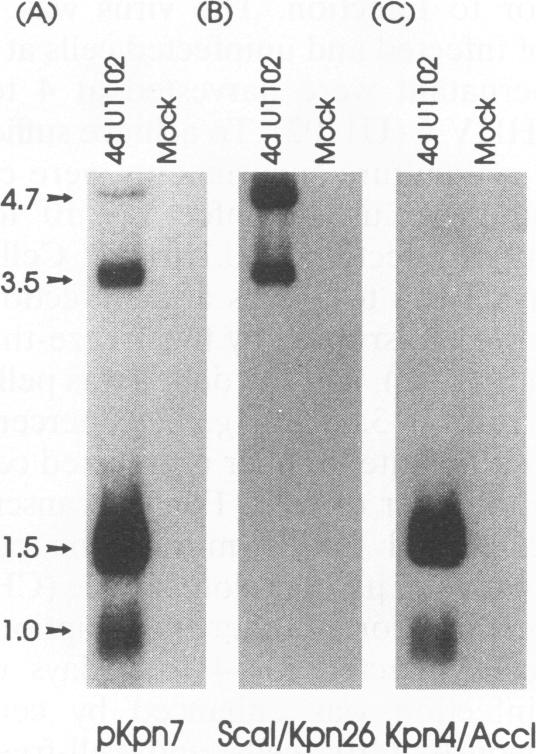
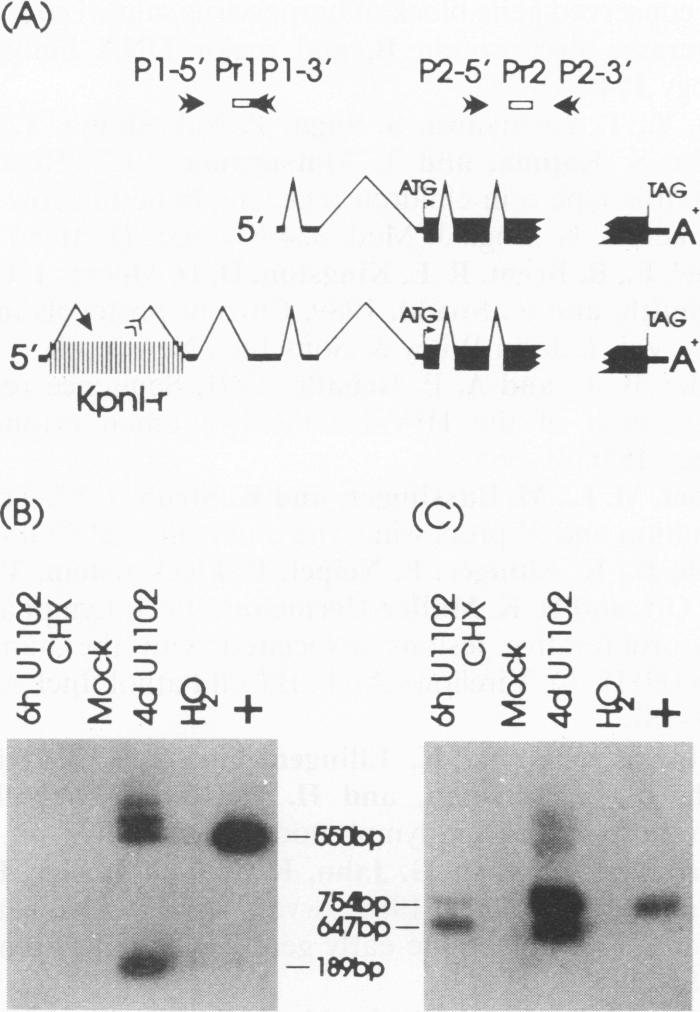
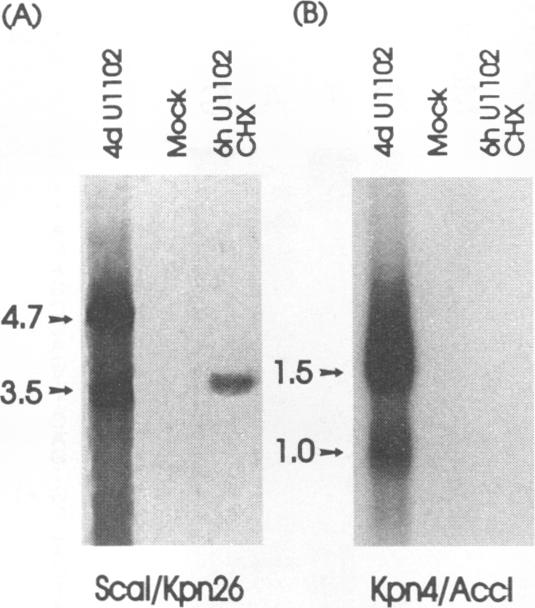
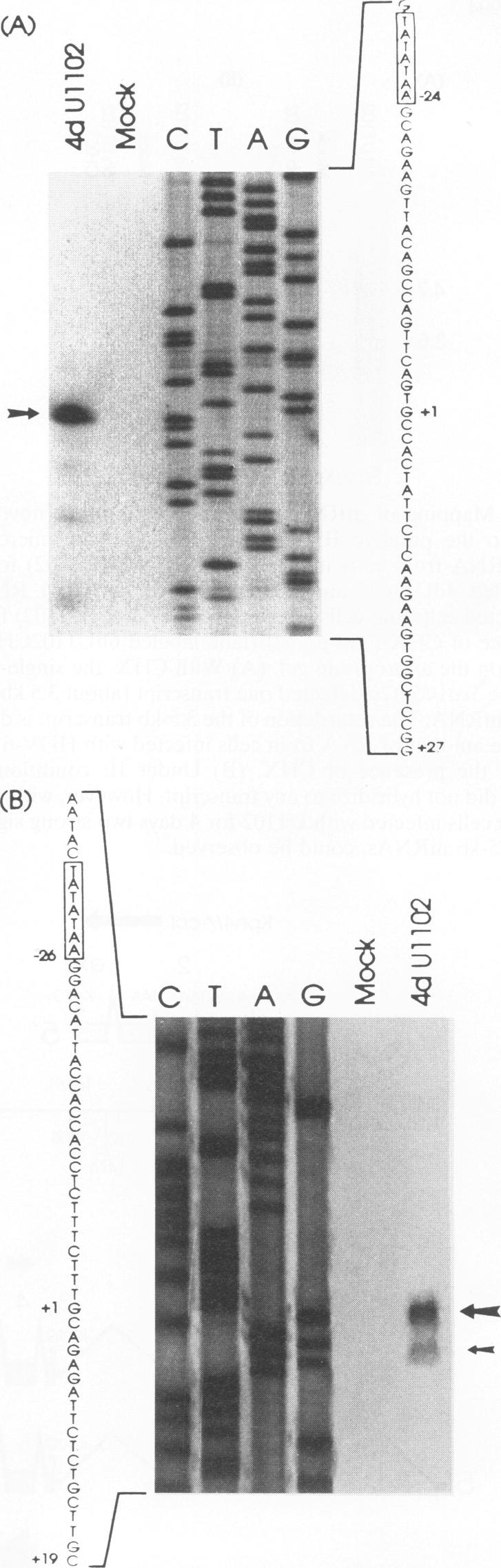
The unique segment of the human herpesvirus 6 (HHV-6) genome is essentially collinear to the unique long DNA segment of another betaherpesvirus, the human cytomegalovirus (HCMV). However, the HHV-6 genomic section that is analogous in position to the major immediate-early (IE) locus of HCMV does not exhibit recognizable sequence homologies. The respective HHV-6 region of 5.5 kbp is flanked on one side by 25 to 28 incomplete tandem repeats of 105 to 110 bp that contain, with one exception, a single KpnI restriction site (KpnI repeats). About 250 reiterations of the sequence motif CACATA are located on the other end. We identified two open reading frames of 375 and 2,595 nucleotides, respectively, on one strand. Strand-specific Northern blot analyses with RNA harvested from HHV-6 (strain U1102)-infected HSB-2 cells or cord blood lymphocytes revealed two transcripts of about 3.5 and 4.7 kb in the corresponding orientation. Sequence analyses of the respective cDNA clones and primer extension experiments were used to map the mRNAs. The two transcripts are coterminal and multiply spliced and code for the same putative 104.6-kDa protein, but they are initiated from different promoters. Characterization of smaller cDNA clones and Northern blotting with other strand-specific probes showed that singly spliced mRNAs of 1.0 and 1.5 kb are transcribed from the opposite strand; they could code for a 17.2-kDa polypeptide. Blocking experiments with cycloheximide led to the conclusion that only the 3.5-kb mRNA is synthesized in the absence of protein biosynthesis upon infection with cell-free virus. This identifies a single IE gene of HHV-6 at the genomic position corresponding to the major IE region of HCMV, although the coding content and transcriptional regulation are quite different for these two herpesvirus IE regions.
人类疱疹病毒6型(HHV-6)基因组的独特片段与另一种β疱疹病毒——人类巨细胞病毒(HCMV)的独特长DNA片段基本共线。然而,HHV-6基因组中与HCMV主要立即早期(IE)基因座位置相似的部分并未表现出可识别的序列同源性。HHV-6的相应5.5kb区域一侧由25至28个105至110bp的不完全串联重复序列侧翼,除一个例外,这些重复序列包含一个单一的KpnI限制性酶切位点(KpnI重复序列)。在另一端大约有250个序列基序CACATA的重复。我们在一条链上分别鉴定出两个开放阅读框,长度分别为375和2595个核苷酸。用从感染HHV-6(U1102株)的HSB-2细胞或脐血淋巴细胞中收获的RNA进行链特异性Northern印迹分析,发现在相应方向上有两个大小约为3.5kb和4.7kb的转录本。通过对相应cDNA克隆的序列分析和引物延伸实验来绘制mRNA图谱。这两个转录本是共末端且经过多次剪接的,编码相同的假定104.6kDa蛋白,但它们起始于不同的启动子。对较小cDNA克隆的表征以及用其他链特异性探针进行的Northern印迹分析表明,1.0kb和1.5kb的单剪接mRNA从相反链转录;它们可能编码一个17.2kDa的多肽。用环己酰亚胺进行的阻断实验得出结论,在用无细胞病毒感染且不存在蛋白质生物合成的情况下,仅合成3.5kb的mRNA。这在与HCMV主要IE区域相对应的基因组位置鉴定出了HHV-6的一个单一IE基因,尽管这两个疱疹病毒IE区域的编码内容和转录调控有很大不同。