Zhu Z, Cai W, Schaffer P A
Division of Molecular Genetics, Dana-Farber Cancer Institute, Boston, Massachusetts.
J Virol. 1994 May;68(5):3027-40. doi: 10.1128/JVI.68.5.3027-3040.1994.
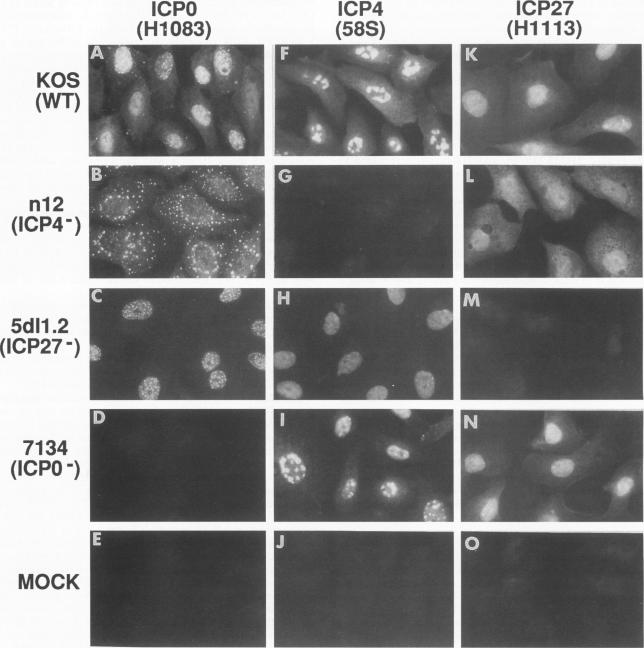
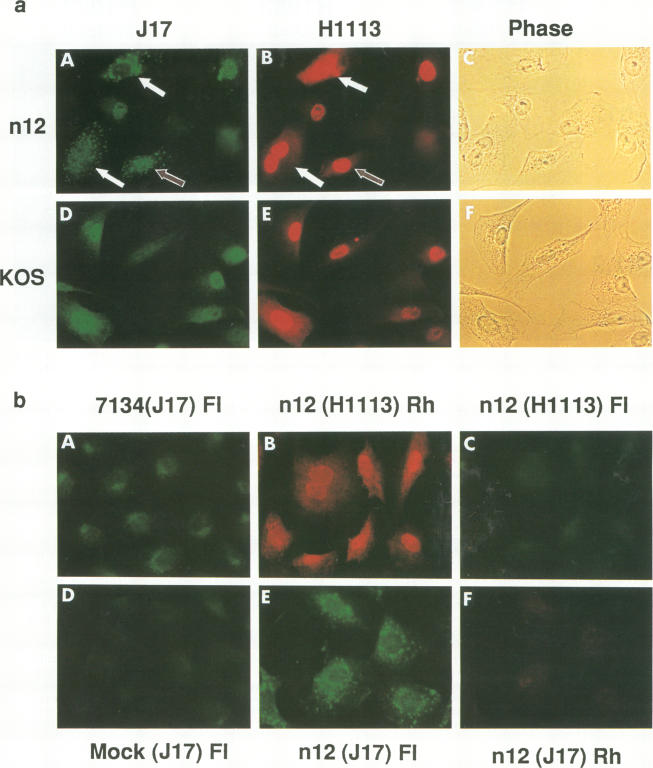
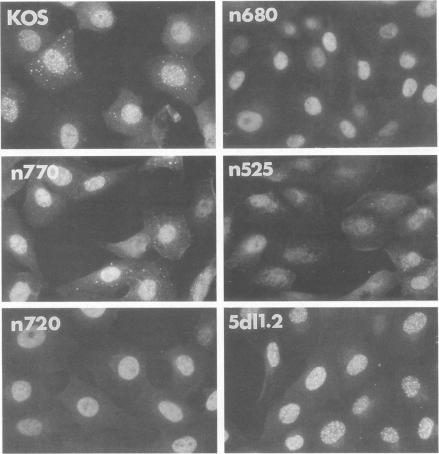
The results of transient expression assays and studies of viral mutants have shown that three of the five immediate-early proteins of herpes simplex virus type 1 (HSV-1) perform regulatory functions, individually and cooperatively. As part of efforts designed to explore the molecular basis for the functional cooperativity among ICP0, ICP4, and ICP27 in the regulation of HSV gene expression, we have examined the intracellular localization of ICP0 in cells infected with ICP4 and ICP27 null mutant viruses by indirect immunofluorescence. Although ICP0 was localized predominantly to the nuclei of wild-type virus-infected cells, it was found exclusively in the nuclei of ICP27 mutant-infected cells and in both the cytoplasm and nuclei of ICP4 mutant-infected cells, the cytoplasmic component being especially strong. These observations indicate that both ICP4 and ICP27 can affect the intracellular localization of ICP0. Transient expression assays with plasmids that express wild-type and mutant forms of ICP0, ICP4, and ICP27 confirmed that ICP4 promotes and that ICP27 inhibits the nuclear localization of ICP0. These results confirm the observations made for mutant virus-infected cells and indicate that the localization pattern seen in infected cells can be established by these three immediate-early proteins exclusive of other viral proteins. The C-terminal half of ICP27 was shown to be required to achieve its inhibitory effect on the nuclear localization of ICP0. The region of ICP0 responsive to ICP27 was mapped to the C terminus of the molecule between amino acid residues 720 and 769. In addition, the concentration of ICP27 was shown to have a significant effect on the intracellular localization of ICP0. Because the major regulatory activities of ICP0, ICP4, and ICP27 are expressed in the nucleus, the ability of these three proteins collectively to determine their own localization patterns within cells adds a new dimension to the complex process of viral gene regulation in HSV.
瞬时表达分析和病毒突变体研究结果表明,单纯疱疹病毒1型(HSV-1)的五种立即早期蛋白中的三种可单独或协同发挥调节功能。作为探索ICP0、ICP4和ICP27在HSV基因表达调控中功能协同性分子基础的工作的一部分,我们通过间接免疫荧光检查了感染ICP4和ICP27缺失突变病毒的细胞中ICP0的细胞内定位。虽然ICP0主要定位于野生型病毒感染细胞的细胞核,但在感染ICP27突变体的细胞的细胞核中单独发现,在感染ICP4突变体的细胞的细胞质和细胞核中均有发现,细胞质成分尤其明显。这些观察结果表明,ICP4和ICP27均可影响ICP0的细胞内定位。用表达野生型和突变型ICP0、ICP4和ICP27的质粒进行的瞬时表达分析证实,ICP4促进而ICP27抑制ICP0的核定位。这些结果证实了对突变病毒感染细胞的观察结果,并表明感染细胞中所见的定位模式可由这三种立即早期蛋白建立,不涉及其他病毒蛋白。ICP27的C端一半被证明是实现其对ICP0核定位抑制作用所必需的。ICP0对ICP27有反应的区域被定位到分子的C端,氨基酸残基在720和769之间。此外,ICP27的浓度对ICP0的细胞内定位有显著影响。由于ICP0、ICP4和ICP27的主要调节活性在细胞核中表达,这三种蛋白共同决定其在细胞内定位模式的能力为HSV病毒基因调控的复杂过程增添了新的维度。