Malo M S, Srivastava K, Andresen J M, Chen X N, Korenberg J R, Ingram V M
Department of Biology, Massachusetts Institute of Technology, Cambridge 02139.
Proc Natl Acad Sci U S A. 1994 Apr 12;91(8):2975-9. doi: 10.1073/pnas.91.8.2975.
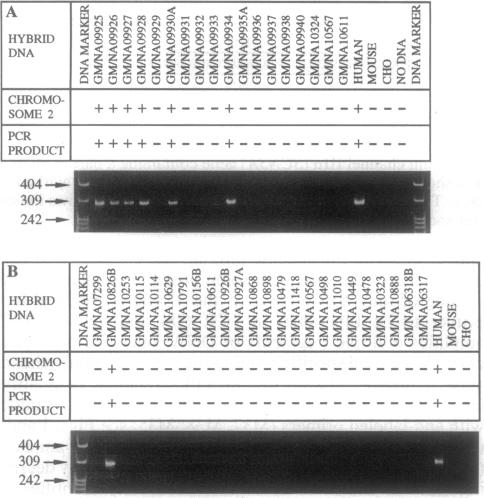
We have developed a low stringency polymerase chain reaction (LSPCR) to isolate the unknown neighboring region around a known DNA sequence, thus allowing efficient targeted gene walking. The method involves the polymerase chain reaction (PCR) with a single primer under conditions of low stringency for primer annealing (40 degrees C) for the first few cycles followed by more cycles at high stringency (55 degrees C). This enables the amplification of a targeted DNA fragment along with other nontargeted fragments. High stringency (55 degrees C) nested PCRs with end-labeled primers are then used to generate a ladder of radioactive bands, which accurately identifies the targeted fragment(s). We performed LSPCR on human placental DNA using a highly conserved sodium channel-specific primer for 5 cycles at 40 degrees C followed by 27 cycles at 55 degrees C for primer annealing. Subsequently, using higher stringency (55 degrees C) PCR with radiolabeled nested primers for 8 cycles, we have isolated a 0.66-kb fragment of a putative human sodium channel gene. Partial sequence (325 bp) of this fragment revealed a 270-bp region (exon) with homology to the rat brain sodium channel III alpha (RBIII) gene at the nucleotide (87%) and amino acid (92%) levels. Therefore, we putatively assign this sequence as a part of a gene coding the alpha-subunit of a human brain type III sodium channel (SCN3A). Using PCR on two human/rodent somatic cell hybrid panels with primers specific to this putative SCN3A gene, we have localized this gene to chromosome 2. Fluorescence in situ hybridization to human metaphase chromosomes was used to sublocalize the SCN3A gene to chromosome at 2q24-31. In conclusion, LSPCR is an efficient and sensitive method for targeted gene walking and is also useful for the isolation of homologous genes in related species.
我们开发了一种低严谨度聚合酶链反应(LSPCR),用于分离已知DNA序列周围未知的相邻区域,从而实现高效的靶向基因步移。该方法包括在低严谨度条件下(40℃)用单个引物进行聚合酶链反应(PCR),最初几个循环用于引物退火,随后在高严谨度(55℃)下进行更多循环。这使得能够扩增靶向DNA片段以及其他非靶向片段。然后使用末端标记引物进行高严谨度(55℃)巢式PCR,以产生一系列放射性条带,从而准确鉴定靶向片段。我们使用高度保守的钠通道特异性引物对人胎盘DNA进行LSPCR,在40℃下进行5个循环,随后在55℃下进行27个循环用于引物退火。随后,使用放射性标记的巢式引物在55℃下进行更高严谨度的PCR,进行8个循环,我们分离出了一个推定的人钠通道基因的0.66 kb片段。该片段的部分序列(325 bp)显示出一个270 bp的区域(外显子),在核苷酸(87%)和氨基酸(92%)水平上与大鼠脑钠通道IIIα(RBIII)基因具有同源性。因此,我们推定该序列是编码人脑III型钠通道(SCN3A)α亚基的基因的一部分。使用针对该推定的SCN3A基因的特异性引物,在两个人/啮齿动物体细胞杂交板上进行PCR,我们已将该基因定位到2号染色体。使用荧光原位杂交技术对人中期染色体进行分析,将SCN3A基因亚定位到2q24 - 31染色体区域。总之,LSPCR是一种用于靶向基因步移的高效且灵敏的方法,也有助于在相关物种中分离同源基因。