Sanchez Y, el-Naggar A, Pathak S, Killary A M
Hematopathology Program, University of Texas M.D. Anderson Cancer Center, Houston 77030.
Proc Natl Acad Sci U S A. 1994 Apr 12;91(8):3383-7. doi: 10.1073/pnas.91.8.3383.
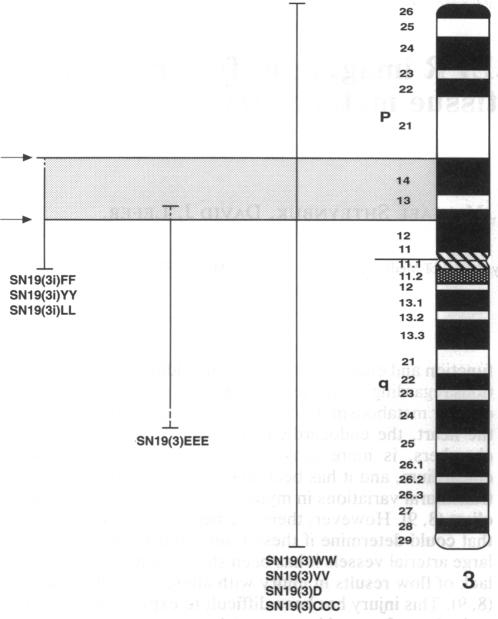
High frequency loss of alleles and cytogenetic aberrations on the short arm of chromosome 3 have been documented in renal cell carcinoma (RCC). Potentially, three distinct regions on 3p could encode tumor suppressor genes involved in the genesis of this cancer. We report that the introduction of a centric fragment of 3p, encompassing 3p14-q11, into a highly malignant RCC cell line resulted in a dramatic suppression of tumor growth in athymic nude mice. Another defined deletion hybrid contained the region 3p12-q24 of the introduced human chromosome and failed to suppress tumorigenicity. These data functionally define a tumor suppressor locus, nonpapillary renal carcinoma-1 (NRC-1), within 3p14-p12, the most proximal region of high frequency allele loss in sporadic RCC as well as the region containing the translocation breakpoint in familial RCC. Furthermore, we provide functional evidence that NRC-1 controls the growth of RCC cells by inducing rapid cell death in vivo.
肾细胞癌(RCC)中已发现3号染色体短臂上等位基因的高频缺失和细胞遗传学畸变。3p上可能有三个不同区域可编码参与该癌症发生的肿瘤抑制基因。我们报告称,将包含3p14-q11的3p着丝粒片段导入高度恶性的RCC细胞系,可显著抑制无胸腺裸鼠体内的肿瘤生长。另一个明确的缺失杂种包含导入人染色体的3p12-q24区域,未能抑制致瘤性。这些数据从功能上定义了一个肿瘤抑制基因座,即非乳头状肾癌-1(NRC-1),位于3p14-p12内,这是散发性RCC中高频等位基因缺失的最近端区域,也是家族性RCC中包含易位断点的区域。此外,我们提供了功能证据表明NRC-1通过在体内诱导快速细胞死亡来控制RCC细胞的生长。