Jefferies H B, Reinhard C, Kozma S C, Thomas G
Friedrich Miescher Institute, Basel, Switzerland.
Proc Natl Acad Sci U S A. 1994 May 10;91(10):4441-5. doi: 10.1073/pnas.91.10.4441.
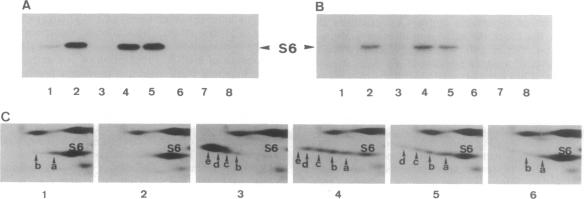
The immunosuppressant rapamycin blocks p70s6k/p85s6k activation and phosphorylation of 40S ribosomal protein S6 in Swiss 3T3 cells. The same net result is obtained when the macrolide is added 3 hr after serum stimulation. In stimulated cells p70s6k/p85s6k inactivation is achieved within minutes, whereas S6 dephosphorylation requires 1-2 hr, supporting the concept that S6 dephosphorylation results from kinase inactivation. In parallel, rapamycin treatment causes a small, but significant, reduction in the initiation rate of protein synthesis, as measured both by [35S]methionine incorporation into protein and by recruitment of 80S ribosomes into polysomes. More striking, analysis of individual mRNA transcripts revealed that rapamycin selectively suppresses the translation of a family of mRNAs that is characterized by a polypyrimidine tract immediately after their N7-methylguanosine cap, a motif that can act as a translational modulator. This family includes transcripts for ribosomal proteins, elongation factors of protein synthesis, and proteins of as-yet-unknown function. The results imply that (i) 40S ribosomes containing phosphorylated S6 may selectively recognize this motif or proteins which bind to it and (ii) rapamycin may inhibit cell growth by blocking S6 phosphorylation and, thus, translation of these mRNAs.
免疫抑制剂雷帕霉素可阻断瑞士3T3细胞中p70s6k/p85s6k的激活以及40S核糖体蛋白S6的磷酸化。血清刺激3小时后添加这种大环内酯类药物也可得到相同的最终结果。在受刺激的细胞中,p70s6k/p85s6k在数分钟内失活,而S6的去磷酸化则需要1 - 2小时,这支持了S6去磷酸化是由激酶失活导致的这一观点。同时,雷帕霉素处理会使蛋白质合成的起始速率出现小幅但显著的降低,这一降低通过[35S]甲硫氨酸掺入蛋白质以及80S核糖体募集到多核糖体中的情况来衡量。更引人注目的是,对单个mRNA转录本的分析表明,雷帕霉素选择性地抑制了一类mRNA的翻译,这类mRNA的特征是在其N7 - 甲基鸟苷帽之后紧接着有一个多嘧啶序列,该基序可作为一种翻译调节因子。这个家族包括核糖体蛋白、蛋白质合成延伸因子以及功能未知的蛋白质的转录本。这些结果表明:(i)含有磷酸化S6的40S核糖体可能选择性地识别这个基序或与其结合的蛋白质;(ii)雷帕霉素可能通过阻断S6磷酸化从而抑制这些mRNA的翻译来抑制细胞生长。