Terada N, Patel H R, Takase K, Kohno K, Nairn A C, Gelfand E W
Department of Pediatrics, National Jewish Center for Immunology and Respiratory Medicine, Denver, CO 80206.
Proc Natl Acad Sci U S A. 1994 Nov 22;91(24):11477-81. doi: 10.1073/pnas.91.24.11477.
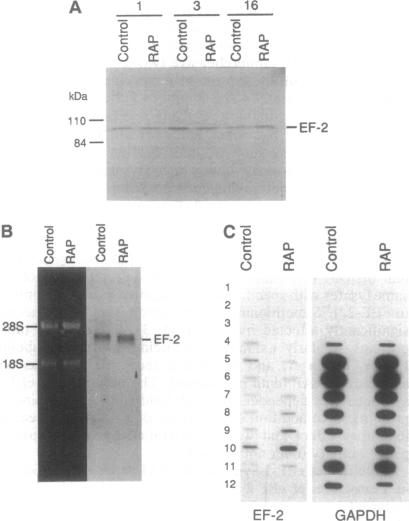
The immunosuppressant rapamycin (RAP) has been demonstrated to specifically inhibit the activity of p70 S6 kinase (p70s6k) and subsequent phosphorylation of ribosomal S6 protein in mammalian cells. Addition of RAP to proliferating lymphoid cells resulted in inhibition of protein synthesis before any changes in the rate of cell proliferation. When the cellular composition of proteins was examined by gel electrophoresis, RAP dramatically inhibited synthesis of selective proteins, particularly elongation factor 2 (eEF-2). The inhibition of eEF-2 synthesis by RAP was at the translational level. Further, RAP inhibited the polysomal association of mRNAs encoding not only eEF-2 but also elongation factor 1-alpha and ribosomal proteins without affecting mRNA translation of any of a number of nonribosomal proteins. Since levels of activity of p70s6k are correlated with the rate of biosynthesis of eEF-2, p70s6k might be involved in coordinate translational regulation of ribosomal protein mRNAs in higher eukaryotes, which have a conserved sequence at their 5' end. Specific inhibition of ribosomal protein synthesis likely explains the differential antiproliferative effect of RAP on proliferating and mitogen-activated quiescent cells.
免疫抑制剂雷帕霉素(RAP)已被证明能特异性抑制哺乳动物细胞中p70 S6激酶(p70s6k)的活性以及核糖体S6蛋白随后的磷酸化。将RAP添加到增殖的淋巴细胞中,在细胞增殖速率发生任何变化之前,就导致了蛋白质合成的抑制。当通过凝胶电泳检查蛋白质的细胞组成时,RAP显著抑制了选择性蛋白质的合成,尤其是延伸因子2(eEF-2)。RAP对eEF-2合成的抑制作用发生在翻译水平。此外,RAP不仅抑制了编码eEF-2的mRNA与多核糖体的结合,还抑制了编码延伸因子1-α和核糖体蛋白的mRNA与多核糖体的结合,而不影响许多非核糖体蛋白中任何一种的mRNA翻译。由于p70s6k的活性水平与eEF-2的生物合成速率相关,p70s6k可能参与了高等真核生物中核糖体蛋白mRNA的协同翻译调控,这些mRNA在其5'端具有保守序列。核糖体蛋白合成的特异性抑制可能解释了RAP对增殖细胞和有丝分裂原激活的静止细胞的不同抗增殖作用。