Lu K P, Means A R
Department of Pharmacology, Duke University Medical Center, Durham, NC 27710.
EMBO J. 1994 May 1;13(9):2103-13. doi: 10.1002/j.1460-2075.1994.tb06486.x.
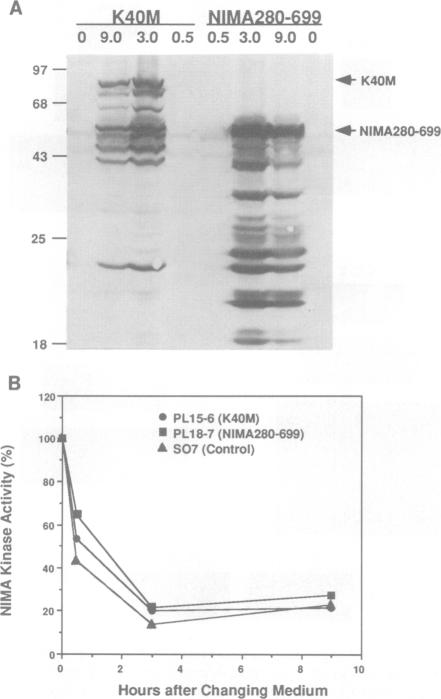
Temperature-sensitive mutation of the nimA gene of Aspergillus nidulans causes a reversible G2 arrest, whereas overexpression of nimA causes premature entry into mitosis from which the cells cannot exit. The nimA gene encodes a Ser/Thr-specific protein kinase (NIMA) which contains an extended COOH-terminal noncatalytic domain. To evaluate the role of this enzyme in nuclear division control, we introduced various mutant nimA cDNAs under the control of the inducible alcohol dehydrogenase gene promoter into a strain of Aspergillus nidulans containing a temperature-sensitive nimA mutation (nimA5). While expression of the wild type NIMA complemented the nimA5 mutation and induced a premature mitotic arrest when overexpressed, expression of a kinase-negative NIMA containing a single amino acid mutation in the putative ATP-binding site could not rescue the nimA5 mutation but resulted in a specific G2 arrest when overexpressed. An identical phenotype was observed with cells expressing only the noncatalytic COOH-terminal domain of NIMA, whereas overexpression of the inactive kinase domain was without effect. The G2 arrest produced by overexpression of the full-length inactive or COOH-terminal NIMA molecules did not prevent activation of the endogenous NIMA or H1 kinase activity precipitable by p13 beads. We suggest that this dominant-negative phenotype results from competitive inhibition of the association of active NIMA with a cellular target(s) and that appropriate targeting is essential for the mitotic function of the NIMA kinase.
构巢曲霉nimA基因的温度敏感突变会导致可逆的G2期阻滞,而nimA基因的过表达会使细胞过早进入有丝分裂且无法从中退出。nimA基因编码一种丝氨酸/苏氨酸特异性蛋白激酶(NIMA),该激酶含有一个延长的COOH末端非催化结构域。为了评估这种酶在核分裂控制中的作用,我们将各种突变的nimA cDNA在可诱导的乙醇脱氢酶基因启动子的控制下导入到含有温度敏感型nimA突变(nimA5)的构巢曲霉菌株中。虽然野生型NIMA的表达补充了nimA5突变,并在过表达时诱导了过早的有丝分裂阻滞,但在假定的ATP结合位点含有单个氨基酸突变的激酶阴性NIMA的表达不能挽救nimA5突变,但在过表达时会导致特异性的G2期阻滞。仅表达NIMA的非催化COOH末端结构域的细胞也观察到了相同的表型,而过表达无活性的激酶结构域则没有效果。全长无活性或COOH末端NIMA分子过表达所产生的G2期阻滞并不能阻止内源性NIMA或可被p13珠子沉淀的H1激酶活性的激活。我们认为这种显性负性表型是由于活性NIMA与细胞靶点结合的竞争性抑制所致,并且适当的靶向对于NIMA激酶的有丝分裂功能至关重要。