Boustany R M, Qian W H, Suzuki K
Division of Pediatric Neurology, Duke University, Durham, NC.
Am J Hum Genet. 1993 Oct;53(4):881-8.
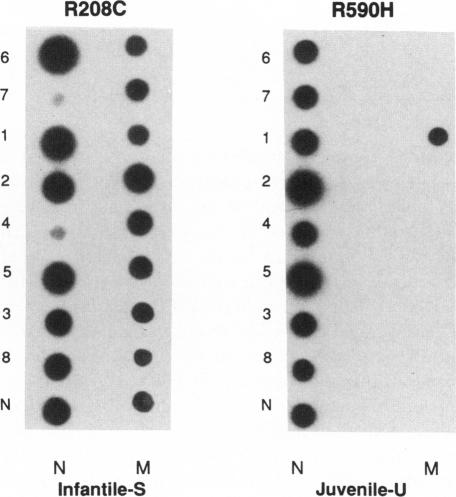
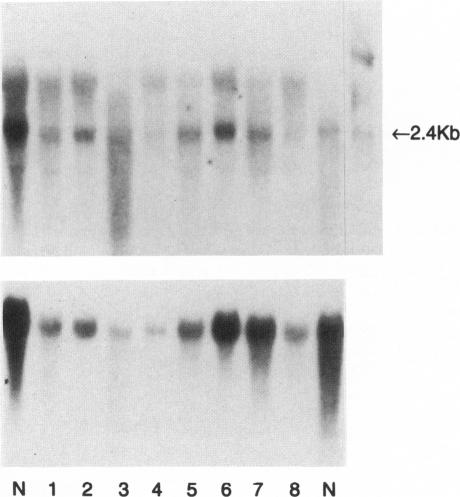
We describe four new mutations in the beta-galactosidase gene. These are the first mutations causing infantile and juvenile GM1-gangliosidosis to be described in American patients. Cell lines from two patients with juvenile and from six patients with infantile GM1-gangliosidosis were analyzed. Northern blot analysis showed the acid beta-galactosidase message to be of normal size and quantity in two juvenile and four infantile cases and of normal size but reduced quantity in two infantile cases. The mutations are distinct from the Japanese mutations. All are point mutations leading to amino acid substitutions: Lys577-->Arg, Arg590-->His, and Glu632-->Gly. The fourth mutation, Arg208-->Cys, accounts for 10 of 16 possible alleles. Two infantile cases from Puerto Rico of Spanish ancestry are homozygous for this mutation, suggesting that this allele may have come to South America and North America via Puerto Rico. That these mutations cause clinical disease was confirmed by marked reduction in catalytic activity of the mutant proteins in the Cos-1 cell expression system.
我们描述了β-半乳糖苷酶基因中的四个新突变。这些是首次在美国患者中描述的导致婴儿型和青少年型GM1神经节苷脂沉积症的突变。对两名青少年GM1神经节苷脂沉积症患者和六名婴儿型GM1神经节苷脂沉积症患者的细胞系进行了分析。Northern印迹分析显示,在两名青少年病例和四名婴儿型病例中,酸性β-半乳糖苷酶信息的大小和数量正常,在两名婴儿型病例中大小正常但数量减少。这些突变与日本的突变不同。所有突变均为导致氨基酸替代的点突变:赖氨酸577→精氨酸、精氨酸590→组氨酸和谷氨酸632→甘氨酸。第四个突变,精氨酸208→半胱氨酸,占16个可能等位基因中的10个。两名来自西班牙裔波多黎各的婴儿型病例对此突变纯合,表明该等位基因可能是通过波多黎各传入南美洲和北美洲的。突变蛋白在Cos-1细胞表达系统中的催化活性显著降低,证实了这些突变会导致临床疾病。