Hazlett L D, Masinick S, Barrett R, Rosol K
Department of Anatomy and Cell Biology, Wayne State University, School of Medicine, Detroit, Michigan 48201.
Infect Immun. 1993 Dec;61(12):5164-73. doi: 10.1128/iai.61.12.5164-5173.1993.
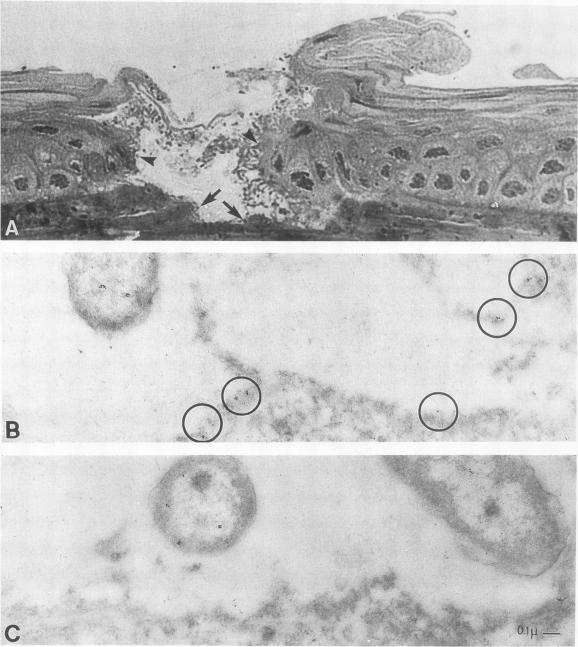
Anti-gangliotetraosylceramide (anti-asialo GM1) and antiparagloboside monoclonal antibodies (MAbs) were used in immunofluorescence, immunoelectron-microscopic, and in vitro binding inhibition assays to determine whether either of the glycolipids was detectable in the normal cornea, whether levels changed following corneal scarification and either trypsin treatment or incubation in vitro with Pseudomonas aeruginosa, and whether either of the MAbs could competitively inhibit P. aeruginosa binding to cornea. No immunostaining above background for either glycolipid was observed in frozen, unfixed sections or in lightly fixed, K4M-embedded antibody-gold-labeled thin sections of normal cornea. In frozen sections of organ-cultured scarified cornea, no increased immunostaining for anti-asialo GM1 or antiparagloboside reactivity was noted immediately or 60 min after corneal scarification. However, at 60 min after scarification and in vitro incubation of the eye with either trypsin or P. aeruginosa, enhanced immunostaining for both glycolipids was associated with cells within or immediately adjacent to the wound site. Trypsin increased immunoreactivity in the wound site more markedly compared with incubation with P. aeruginosa, but immunostaining was similarly localized with either treatment. No staining above background was seen in control sections. Similarly, with immunoelectron microscopy, increased immunogold-MAb staining for both glycolipids was seen on the plasma membranes of the wound-site cells of eyes incubated with either trypsin or P. aeruginosa compared with controls that were similarly immunostained but with the primary antibody either omitted or substituted with a nonspecific MAb. Competitive binding inhibition assays, in which the bacterial inoculum or the eye in organ culture was incubated with anti-asialo GM1 MAb prior to topical ocular application of the bacteria, showed significantly decreased P. aeruginosa adhesion compared with preparations similarly treated with phosphate-buffered saline or antiparagloboside MAb. These data provide evidence to support the hypothesis that asialo GM1, not paragloboside, serves as a receptor for P. aeruginosa binding to the scarified cornea of the adult mouse and spatially localizes both glycolipids in the wound site.
抗神经节四糖神经酰胺(抗唾液酸化GM1)和抗副球蛋白单克隆抗体(MAb)被用于免疫荧光、免疫电子显微镜及体外结合抑制试验,以确定这两种糖脂在正常角膜中是否可被检测到,角膜划痕以及胰蛋白酶处理或与铜绿假单胞菌体外孵育后其水平是否发生变化,以及这两种单克隆抗体是否能够竞争性抑制铜绿假单胞菌与角膜的结合。在正常角膜的冷冻、未固定切片或轻度固定、K4M包埋的抗体金标记薄切片中,未观察到高于背景的两种糖脂免疫染色。在器官培养的划痕角膜的冷冻切片中,角膜划痕后即刻或60分钟时,未发现抗唾液酸化GM1或抗副球蛋白反应性的免疫染色增加。然而,在划痕后60分钟以及用胰蛋白酶或铜绿假单胞菌对眼进行体外孵育时,两种糖脂的增强免疫染色与伤口部位内或紧邻伤口部位的细胞相关。与用铜绿假单胞菌孵育相比,胰蛋白酶使伤口部位的免疫反应性增加更为明显,但两种处理的免疫染色定位相似。在对照切片中未见到高于背景的染色。同样,在免疫电子显微镜下,与用省略一抗或用非特异性单克隆抗体替代一抗进行类似免疫染色的对照相比,在用胰蛋白酶或铜绿假单胞菌孵育的眼的伤口部位细胞的质膜上,观察到两种糖脂的免疫金单克隆抗体染色增加。竞争性结合抑制试验中,在局部眼部应用细菌之前,将细菌接种物或器官培养中的眼与抗唾液酸化GM1单克隆抗体一起孵育,结果显示与用磷酸盐缓冲盐水或抗副球蛋白单克隆抗体进行类似处理的制剂相比,铜绿假单胞菌的黏附显著减少。这些数据为支持以下假说提供了证据:唾液酸化GM1而非副球蛋白是铜绿假单胞菌与成年小鼠划痕角膜结合的受体,并且这两种糖脂在伤口部位在空间上进行定位。