Nabel E G, Shum L, Pompili V J, Yang Z Y, San H, Shu H B, Liptay S, Gold L, Gordon D, Derynck R
Department of Internal Medicine, University of Michigan Medical Center, Ann Arbor 48109-0688.
Proc Natl Acad Sci U S A. 1993 Nov 15;90(22):10759-63. doi: 10.1073/pnas.90.22.10759.
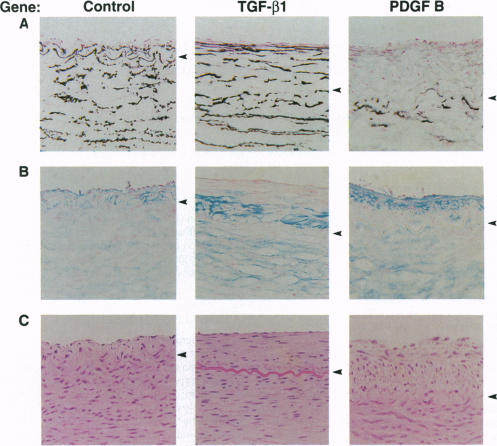
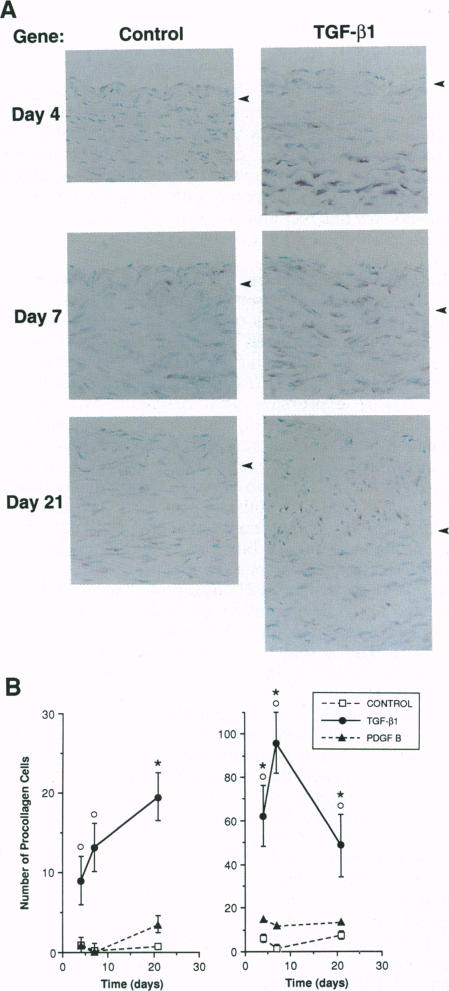
The arterial wall responds to thrombosis or mechanical injury through the induction of specific gene products that increase cellular proliferation and connective tissue formation. These changes result in intimal hyperplasia that is observed in restenosis and the early phases of atherosclerosis. Transforming growth factor beta 1 (TGF-beta 1) is a secreted multi-functional protein that plays an important role in embryonal development and in repair following tissue injury. However, the function of TGF-beta 1 in vascular cell growth in vivo has not been defined. In this report, we have evaluated the role of TGF-beta 1 in the pathophysiology of intimal and medial hyperplasia by gene transfer of an expression plasmid encoding active TGF-beta 1 into porcine arteries. Expression of TGF-beta 1 in normal arteries resulted in substantial extracellular matrix production accompanied by intimal and medial hyperplasia. Increased procollagen, collagen, and proteoglycan synthesis in the neointima was demonstrated by immunohistochemistry relative to control transfected arteries. Expression of TGF-beta 1 induced a distinctly different program of gene expression and biologic response from the platelet-derived growth factor B (PDGF B) gene: procollagen synthesis induced by TGF-beta 1 was greater, and cellular proliferation was less prominent. These findings show that TGF-beta 1 differentially modulates extracellular matrix production and cellular proliferation in the arterial wall in vivo and could play a reparative role in the response to arterial injury.
动脉壁通过诱导特定基因产物来应对血栓形成或机械损伤,这些基因产物会增加细胞增殖和结缔组织形成。这些变化导致内膜增生,这在再狭窄和动脉粥样硬化的早期阶段均可观察到。转化生长因子β1(TGF-β1)是一种分泌型多功能蛋白,在胚胎发育和组织损伤后的修复中起重要作用。然而,TGF-β1在体内血管细胞生长中的功能尚未明确。在本报告中,我们通过将编码活性TGF-β1的表达质粒基因转移到猪动脉中,评估了TGF-β1在内膜和中膜增生病理生理学中的作用。TGF-β1在正常动脉中的表达导致大量细胞外基质产生,并伴有内膜和中膜增生。相对于对照转染动脉,免疫组织化学显示新生内膜中前胶原、胶原和蛋白聚糖合成增加。TGF-β1的表达诱导了与血小板衍生生长因子B(PDGF B)基因明显不同的基因表达程序和生物学反应:TGF-β1诱导的前胶原合成更多,而细胞增殖则不那么突出。这些发现表明,TGF-β1在体内对动脉壁中的细胞外基质产生和细胞增殖具有不同的调节作用,并可能在对动脉损伤的反应中发挥修复作用。