Mellits K H, Hay R T, Goodbourn S
Gene Expression Laboratory, Imperial Cancer Research Fund, London, UK.
Nucleic Acids Res. 1993 Nov 11;21(22):5059-66. doi: 10.1093/nar/21.22.5059.
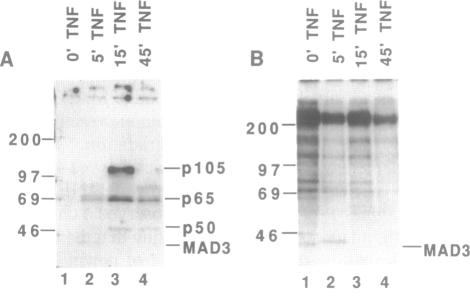
We have studied the role of protein turnover in the induction of NF-kappa B DNA binding activity. Treatment of cells with tumour necrosis factor (TNF), double-stranded RNA (dsRNA), or phorbol esters is shown to be associated with an increase in the rate of p105 to p50 processing, and the loss of immunologically detectable MAD3/I kappa B alpha. Phosphate-labelling experiments indicate that these events are preceded by the phosphorylation of MAD3 and p105. The protease inhibitors TLCK (N alpha-p-Tosyl-L-Lysine Chloromethyl Ketone) and TPCK (N alpha-p-Tosyl-L-Phenylalanine Chloromethyl Ketone) inhibit both p105 to p50 processing and MAD3 degradation, and also cause a complete block to NF-kappa B activation. These data suggest a model for NF-kappa B activation in which phosphorylation destabilises the NF-kappa B/MAD3 complex but that, in vivo, this is insufficient to lead to activation in the absence of an obligatory mechanism that degrades MAD3.
我们研究了蛋白质周转在诱导核因子-κB(NF-κB)DNA结合活性中的作用。结果显示,用肿瘤坏死因子(TNF)、双链RNA(dsRNA)或佛波酯处理细胞,与p105至p50加工速率的增加以及免疫可检测的MAD3/IκBα的丢失有关。磷酸标记实验表明,这些事件之前是MAD3和p105的磷酸化。蛋白酶抑制剂TLCK(Nα-p-甲苯磺酰-L-赖氨酸氯甲基酮)和TPCK(Nα-p-甲苯磺酰-L-苯丙氨酸氯甲基酮)既抑制p105至p50的加工,也抑制MAD3的降解,并且还完全阻断NF-κB的激活。这些数据提示了一种NF-κB激活模型,其中磷酸化使NF-κB/MAD3复合物不稳定,但在体内,在没有降解MAD3的必要机制的情况下,这不足以导致激活。