Lanza P, Billetta R, Antonenko S, Zanetti M
Department of Medicine, University of California, San Diego, La Jolla 92093-0961.
Proc Natl Acad Sci U S A. 1993 Dec 15;90(24):11683-7. doi: 10.1073/pnas.90.24.11683.
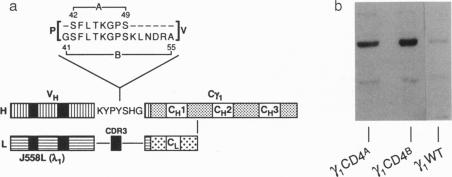
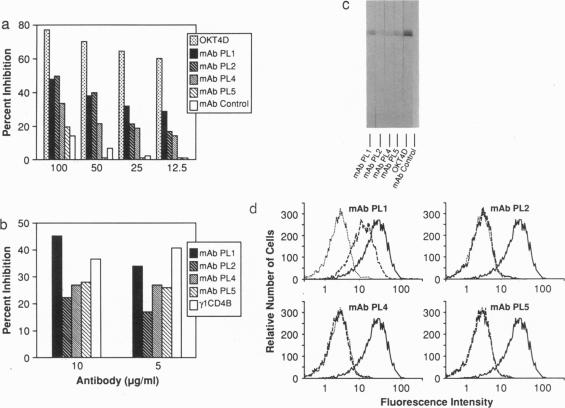
Using the process of "antibody antigenization," we engineered two antibody molecules carrying in the third complementarity-determining region of the heavy chain variable domain a 7-mer or a 15-mer peptide epitope of the first extracellular domain (D1) of human CD4 receptor--namely, Ser-Phe-Leu-Thr-Lys-Gly-Pro-Ser (SFLTKGPS; positions 42 through 49) and Gly-Ser-Phe-Leu-Thr-Lys-Gly-Pro-Ser-Lys-Leu-Asn-Asp-Arg-Ala (GSFLTKGPSKLNDRA; positions 41 through 55). These amino acid sequences are contained in the consensus binding site for the human immunodeficiency virus (HIV) on CD4 receptor. Both antigenized antibodies (AgAbs) bound recombinant gp120 and were recognized by a prototype monoclonal antibody to CD4 whose binding site is within amino acid residues 41-55. AgAbs were then used as immunogens in rabbits and mice to elicit a humoral response against CD4. Only the AgAb carrying the sequence 41GSFLTKGPSKLN-DRA55 induced a response against CD4. The induced antibodies showed specificity for the amino acid sequence of CD4 engineered in the AgAb molecule, were able to inhibit the formation of syncytia between human CD4+ T cells MOLT-3 and 8E5 (T cells that are constitutively infected with HIV), and stained human CD4+ CEM T cells. Four murine monoclonal antibodies were used to analyze the relationship between syncytia inhibition and CD4 binding at the single antibody level, and indicated that recognition of native CD4 is not an absolute requirement for inhibition of syncytia. This study demonstrates that antigenized antibodies can be used as immunogens to elicit site-specific and biologically active immunity to CD4. The importance of this approach as a general way to induce anti-receptor immunity and as a possible new measure to immunointervention in HIV infection is discussed.
利用“抗体抗原化”过程,我们构建了两个抗体分子,它们在重链可变区的第三个互补决定区携带人CD4受体第一胞外结构域(D1)的一个7聚体或一个15聚体肽表位,即Ser-Phe-Leu-Thr-Lys-Gly-Pro-Ser(SFLTKGPS;第42至49位)和Gly-Ser-Phe-Leu-Thr-Lys-Gly-Pro-Ser-Lys-Leu-Asn-Asp-Arg-Ala(GSFLTKGPSKLNDRA;第41至55位)。这些氨基酸序列包含在CD4受体上人类免疫缺陷病毒(HIV)的共有结合位点中。两种抗原化抗体(AgAbs)均能结合重组gp120,并被一种针对CD4的原型单克隆抗体识别,该单克隆抗体的结合位点在氨基酸残基41 - 55内。然后将AgAbs用作兔和小鼠的免疫原,以引发针对CD4的体液免疫反应。只有携带序列41GSFLTKGPSKLN - DRA55的AgAb诱导了针对CD4的反应。诱导产生的抗体对AgAb分子中构建的CD4氨基酸序列具有特异性,能够抑制人CD4 + T细胞MOLT - 3和8E5(持续感染HIV的T细胞)之间的合胞体形成,并对人CD4 + CEM T细胞进行染色。使用四种鼠单克隆抗体在单抗体水平分析合胞体抑制与CD4结合之间的关系,结果表明识别天然CD4并非抑制合胞体的绝对必要条件。本研究表明,抗原化抗体可作为免疫原引发针对CD4的位点特异性和生物活性免疫。讨论了这种方法作为诱导抗受体免疫的一般方法以及作为HIV感染免疫干预可能新措施的重要性。