
站立时视觉和站立宽度对人体运动的影响:对横向摆动传入控制的启示
Effect of vision and stance width on human body motion when standing: implications for afferent control of lateral sway.
作者信息
Day B L, Steiger M J, Thompson P D, Marsden C D
机构信息
MRC Human Movement and Balance Unit, Institute of Neurology, London.
出版信息
J Physiol. 1993 Sep;469:479-99. doi: 10.1113/jphysiol.1993.sp019824.
Abstract
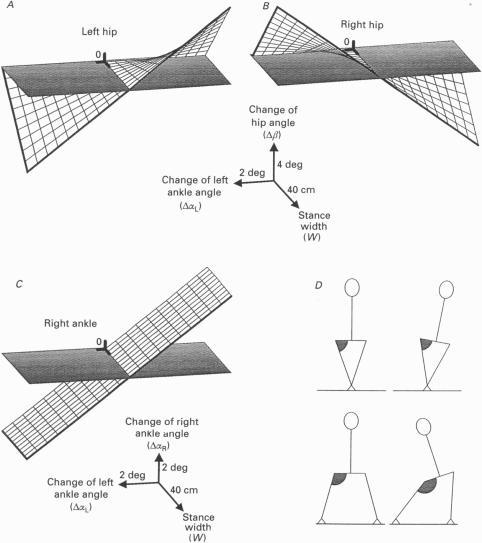
- Measurements of human upright body movements in three dimensions have been made on thirty-five male subjects attempting to stand still with various stance widths and with eyes closed or open. Body motion was inferred from movements of eight markers fixed to specific sites on the body from the shoulders to the ankles. Motion of these markers was recorded together with motion of the point of application of the resultant of the ground reaction forces (centre of pressure). 2. The speed of the body (average from eight sites) was increased by closing the eyes or narrowing the stance width and there was an interaction between these two factors such that vision reduced body speed more effectively when the feet were closer together. Similar relationships were found for components of velocity both in the frontal and sagittal planes although stance width exerted a much greater influence on the lateral velocity component. 3. Fluctuations in position of the body were also increased by eye closure or narrowing of stance width. Again, the effect of stance width was more potent for lateral than for anteroposterior movements. In contrast to the velocity measurements, there was no interaction between vision and stance width. 4. There was a progressive increase in the amplitude of position and velocity fluctuations from markers placed higher on the body. The fluctuations in the position of the centre of pressure were similar in magnitude to those of the markers placed near the hip. The fluctuations in velocity of centre of pressure, however, were greater than of any site on the body. 5. Analysis of the amplitude of angular motion between adjacent straight line segments joining the markers suggests that the inverted pendulum model of body sway is incomplete. Motion about the ankle joint was dominant only for lateral movement in the frontal plane with narrow stance widths (< 8 cm). For all other conditions most angular motion occurred between the trunk and leg. 6. The large reduction in lateral body motion with increasing stance width was mainly due to a disproportionate reduction in the angular motion about the ankles and feet. A mathematical model of the skeletal structure has been constructed which offers some explanation for this specific reduction in joint motion.(ABSTRACT TRUNCATED AT 400 WORDS)
摘要
- 对35名男性受试者在不同站立宽度、闭眼或睁眼状态下试图静止站立时的人体三维直立运动进行了测量。通过固定在从肩部到脚踝身体特定部位的8个标记的运动来推断身体运动。这些标记的运动与地面反作用力合力的作用点(压力中心)的运动一起被记录下来。2. 闭眼或缩小站立宽度会增加身体速度(八个部位的平均值),并且这两个因素之间存在相互作用,即当双脚靠得更近时,视觉能更有效地降低身体速度。在额面和矢状面内,速度分量也发现了类似的关系,尽管站立宽度对横向速度分量的影响更大。3. 闭眼或缩小站立宽度也会增加身体位置的波动。同样,站立宽度对横向运动的影响比对前后运动的影响更大。与速度测量结果不同,视觉和站立宽度之间没有相互作用。4. 身体上位置较高的标记的位置和速度波动幅度逐渐增加。压力中心位置的波动幅度与髋部附近标记的波动幅度相似。然而,压力中心速度的波动大于身体上任何部位的波动。5. 对连接标记的相邻直线段之间角运动幅度的分析表明,身体摆动的倒立摆模型是不完整的。仅在窄站立宽度(<8厘米)的额面横向运动中,踝关节周围的运动占主导。在所有其他情况下,大多数角运动发生在躯干和腿部之间。6. 随着站立宽度增加,身体横向运动大幅减少主要是由于踝关节和脚部周围角运动不成比例地减少。已经构建了一个骨骼结构的数学模型,该模型对关节运动的这种特定减少提供了一些解释。(摘要截取自400字)

 Zotero 插件