Schmitt M G, Phillips R B, Matzen R N, Rodey G
Department of Medicine, Medical College of Wisconsin, Milwaukee 53226.
Am J Hum Genet. 1975 May;27(3):315-21.
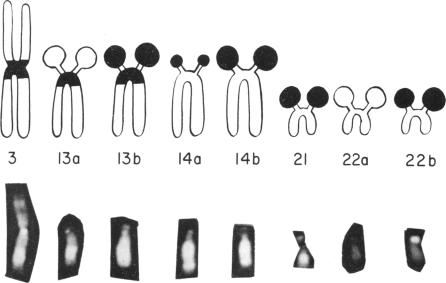
Twenty-four members (4 generations) of a family with alpha 1 antitrypsin deficiency were studied in an attempt to determine the chromosomal location of the Pi system locus. Three alpha 1 antitrypsin alleles (PiM, PiI, and PiZ) and five phenotypes (MM, MZ, MI, IZ, and ZZ) were detected in family members. The quinacrine fluorescent banding technique was successfully utilized to reveal eight polymorphic chromosomal markers in family members. Eight red cell antigens and HL-A antigens were identified for each family member. No linkage between the Pi system and chromosomal markers, four polymorphic red cell antigens, and HL-A antigens was detected. On the basis of this family study, the Pi locus as defined by alpha 1 antitrypsin deficiency does not appear to be on chromosomes 2, 3, 13, 14, 21, or 22 within measurable distance of the markers used.
为了确定Pi系统基因座的染色体定位,对一个患有α1抗胰蛋白酶缺乏症的家族的24名成员(4代)进行了研究。在家族成员中检测到了3种α1抗胰蛋白酶等位基因(PiM、PiI和PiZ)和5种表型(MM、MZ、MI、IZ和ZZ)。成功利用喹吖因荧光显带技术揭示了家族成员中的8种多态性染色体标记。为每个家族成员鉴定了8种红细胞抗原和HL - A抗原。未检测到Pi系统与染色体标记、4种多态性红细胞抗原和HL - A抗原之间的连锁关系。基于这项家族研究,由α1抗胰蛋白酶缺乏症定义的Pi基因座似乎不在所用标记可测量距离内的2号、3号、13号、14号、21号或22号染色体上。