Winston J T, Pledger W J
Department of Cell Biology, Vanderbilt University School of Medicine, Nashville, Tennessee 37232.
Mol Biol Cell. 1993 Nov;4(11):1133-44. doi: 10.1091/mbc.4.11.1133.
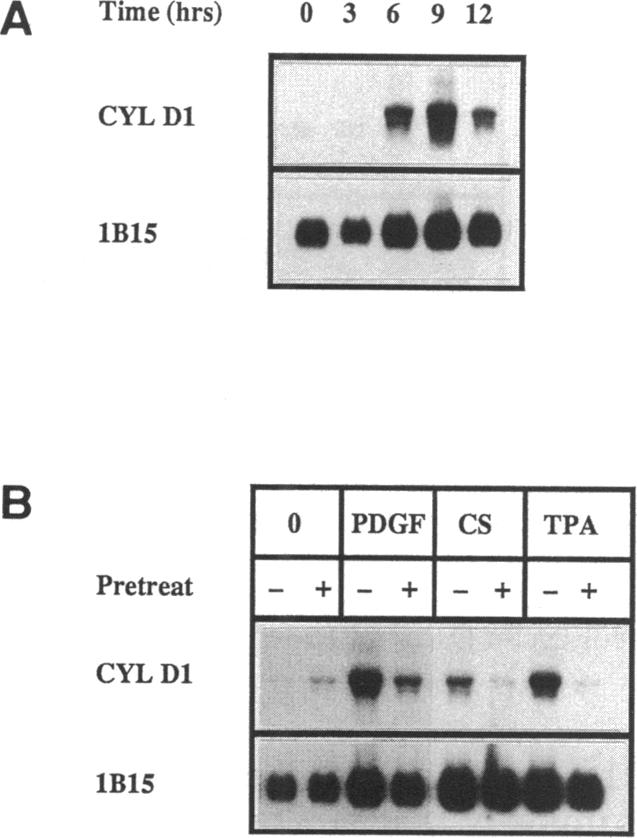
Overexpression of the cyclin D1/PRAD1 oncogene has been observed in a number of tumorigenic cell lines, suggesting that regulation of D1 expression may represent an important step in the control of cellular proliferation. We have examined the mRNA expression of cyclin D1, as well as two related D-type cyclins, D2 and D3, in response to defined growth factors that control the growth of Balb/c-3T3 fibroblasts. Transcripts for all three D-type cyclins were expressed during the G1 phase of the Balb cell cycle, however only D1 and D3 exhibited periodic induction. Although redundantly expressed, message levels of cyclin D1 and D3 were differentially regulated in regard to kinetics of induction; a modest increase in D3 mRNA was detected near the G1/S boundary, 12 h after serum stimulation of quiescent cells, while abundance of D1 transcript increased 20 to 30-fold, peaking 6 h after addition of serum. Factors such as platelet-derived growth factor (PDGF) that induce competence formation in Balb cells, increased D1 message and protein levels to the same extent as serum but did not affect expression of cyclin D3 and did not stimulate entry into S phase. Progression factors contained within platelet-poor plasma stimulated D1 expression only weakly but acted synergistically with low concentrations of PDGF to increase D1 mRNA to maximum levels. Depletion of protein kinase C severely reduced the ability of PDGF and serum to induce D1 mRNA. PDGF- and serum-mediated elevation of steady-state D1 message levels was in part because of a transcriptional activation of the D1 gene that was independent of protein synthesis. However, protein synthesis was required 3-4 h after serum stimulation for the shut down of D1 transcription leading to the normal decline in message levels after peak induction. Our results indicate that overexpression of cyclin D1 message may result from a disruption of negative regulatory events that repress D1 transcription.
在许多致瘤细胞系中都观察到细胞周期蛋白D1/PRAD1癌基因的过表达,这表明D1表达的调控可能是控制细胞增殖的重要一步。我们检测了细胞周期蛋白D1以及另外两种相关的D型细胞周期蛋白D2和D3的mRNA表达,以响应控制Balb/c-3T3成纤维细胞生长的特定生长因子。在Balb细胞周期的G1期,所有三种D型细胞周期蛋白的转录本都有表达,但只有D1和D3呈现周期性诱导。尽管有冗余表达,但细胞周期蛋白D1和D3的信息水平在诱导动力学方面受到不同的调控;在静止细胞血清刺激12小时后,接近G1/S边界时检测到D3 mRNA有适度增加,而D1转录本的丰度增加了20到30倍,在添加血清后6小时达到峰值。诸如血小板衍生生长因子(PDGF)等在Balb细胞中诱导能力形成的因子,使D1信息和蛋白水平增加到与血清相同的程度,但不影响细胞周期蛋白D3的表达,也不刺激进入S期。贫血小板血浆中含有的进展因子仅微弱刺激D1表达,但与低浓度的PDGF协同作用,将D1 mRNA增加到最大水平。蛋白激酶C的缺失严重降低了PDGF和血清诱导D1 mRNA的能力。PDGF和血清介导的稳态D1信息水平升高部分是由于D1基因的转录激活,该激活独立于蛋白质合成。然而,血清刺激后3 - 4小时需要蛋白质合成来关闭D转录,从而导致诱导峰值后信息水平正常下降。我们的结果表明,细胞周期蛋白D1信息的过表达可能是由于抑制D1转录的负调控事件的破坏所致。