Sanseverino J, Applegate B M, King J M, Sayler G S
Center for Environmental Biotechnology, University of Tennessee, Knoxville 37932.
Appl Environ Microbiol. 1993 Jun;59(6):1931-7. doi: 10.1128/aem.59.6.1931-1937.1993.
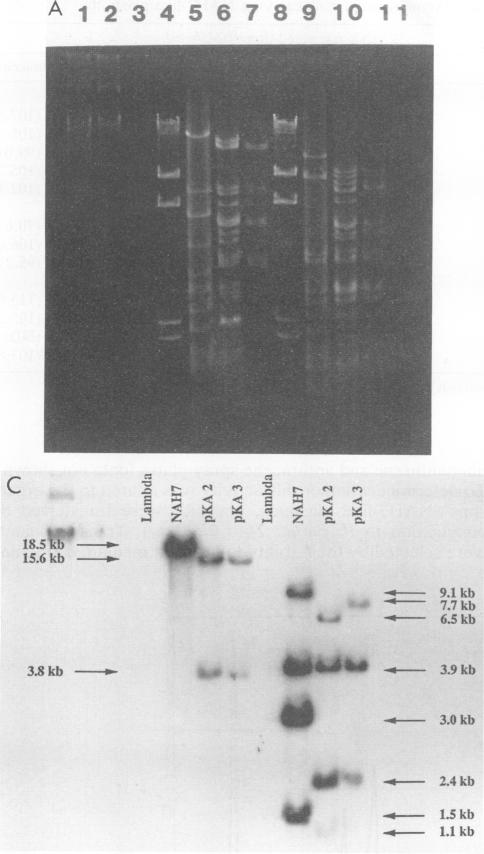
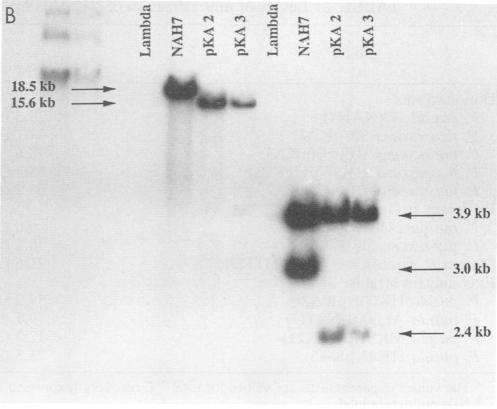
The well-characterized plasmid-encoded naphthalene degradation pathway in Pseudomonas putida PpG7(NAH7) was used to investigate the role of the NAH plasmid-encoded pathway in mineralizing phenanthrene and anthracene. Three Pseudomonas strains, designated 5R, DFC49, and DFC50, were recovered from a polynuclear aromatic hydrocarbon-degrading inoculum developed from a manufactured gas plant soil slurry reactor. Plasmids pKA1, pKA2, and pKA3, approximately 100 kb in size, were isolated from these strains and characterized. These plasmids have homologous regions of upper and lower NAH7 plasmid catabolic genes. By conjugation experiments, these plasmids, including NAH7, have been shown to encode the genotype for mineralization of [9-14C]phenanthrene and [U-14C]anthracene, as well as [1-14C]naphthalene. One strain, Pseudomonas fluorescens 5RL, which has the complete lower pathway inactivated by transposon insertion in nahG, accumulated a metabolite from phenanthrene and anthracene degradation. This is the first direct evidence to indicate that the NAH plasmid-encoded catabolic genes are involved in degradation of polynuclear aromatic hydrocarbons other than naphthalene.
利用恶臭假单胞菌PpG7(NAH7)中特征明确的质粒编码萘降解途径,研究NAH质粒编码途径在菲和蒽矿化中的作用。从一个由制造煤气厂土壤泥浆反应器开发的多环芳烃降解接种物中分离出三株假单胞菌,分别命名为5R、DFC49和DFC50。从这些菌株中分离出大小约为100 kb的质粒pKA1、pKA2和pKA3,并对其进行了表征。这些质粒具有与NAH7质粒上下分解代谢基因同源的区域。通过接合实验,已证明这些质粒,包括NAH7,编码[9-14C]菲、[U-14C]蒽以及[1-14C]萘矿化的基因型。一株荧光假单胞菌5RL,其完整的下游途径因nahG中的转座子插入而失活,积累了菲和蒽降解的一种代谢产物。这是第一个直接证据,表明NAH质粒编码的分解代谢基因参与了除萘以外的多环芳烃的降解。