Takashima A, Noguchi K, Sato K, Hoshino T, Imahori K
Mitsubishi Kasei Institute of Life Sciences, Tokyo, Japan.
Proc Natl Acad Sci U S A. 1993 Aug 15;90(16):7789-93. doi: 10.1073/pnas.90.16.7789.
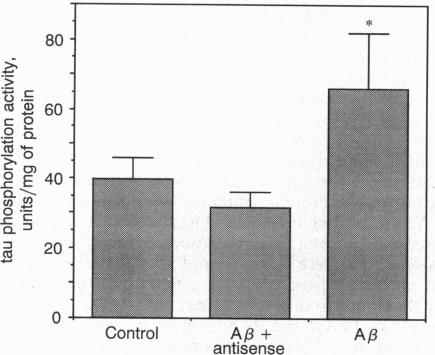
Pathological changes of Alzheimer disease are characterized by cerebral cortical atrophy as a result of degeneration and loss of neurons. Typical histological lesions include numerous senile plaques composed of deposits of amyloid beta-protein and neurofibrillary tangles consisting predominantly of ubiquitin and highly phosphorylated tau proteins. Previously, tau protein kinase I (TPK I) was purified and its cDNA was cloned. To examine the biological role of this enzyme in neurons, we have studied the induction of its kinase activity in primary cultures of embryonic rat hippocampal neurons. Treatment of cultures with amyloid beta-protein significantly increased TPK I activity and induced the appearance of tau proteins recognized by the Alz-50 monoclonal antibody. In addition, though amyloid beta-protein was neurotoxic, either cycloheximide or actinomycin D prevented neuronal death. Death was also prevented by TPK I antisense oligonucleotides but not by sense oligonucleotides. These observations suggest that rat hippocampal neurons undergo programmed cell death in response to amyloid beta-protein and that TPK I is a key enzyme in this process.
阿尔茨海默病的病理变化特征为由于神经元变性和丧失导致的大脑皮质萎缩。典型的组织学病变包括由β-淀粉样蛋白沉积组成的大量老年斑以及主要由泛素和高度磷酸化的tau蛋白组成的神经原纤维缠结。此前,已纯化了tau蛋白激酶I(TPK I)并克隆了其cDNA。为了研究该酶在神经元中的生物学作用,我们研究了其在原代培养的胚胎大鼠海马神经元中的激酶活性诱导情况。用β-淀粉样蛋白处理培养物可显著增加TPK I活性,并诱导出被Alz-50单克隆抗体识别的tau蛋白的出现。此外,尽管β-淀粉样蛋白具有神经毒性,但放线菌酮或放线菌素D均可防止神经元死亡。TPK I反义寡核苷酸也可防止神经元死亡,但正义寡核苷酸则不能。这些观察结果表明,大鼠海马神经元会因β-淀粉样蛋白而发生程序性细胞死亡,且TPK I是这一过程中的关键酶。