Frank E G, Hauser J, Levine A S, Woodgate R
Section on DNA Replication, Repair, and Mutagenesis, National Institute of Child Health and Human Development, National Institutes of Health, Bethesda, MD 20892.
Proc Natl Acad Sci U S A. 1993 Sep 1;90(17):8169-73. doi: 10.1073/pnas.90.17.8169.
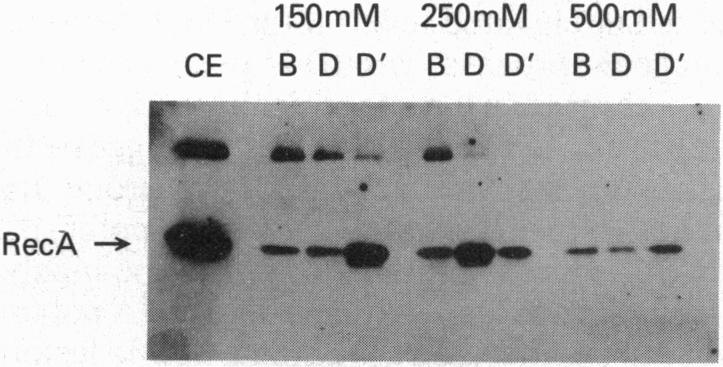
In addition to its critical role in genetic recombination, the Escherichia coli RecA protein plays a pivotal role in SOS-induced mutagenesis. This role can be separated genetically into three steps: (i) depression of the SOS regulon by mediating the posttranslational cleavage of the LexA repressor, (ii) activation of UmuD'-like proteins by mediating cleavage of the UmuD-like proteins, and (iii) a direct step, possibly to interact with and to target the Umu-like mutagenesis proteins to lesions in DNA. We have analyzed RecA's third role biochemically using protein affinity chromatography and an agarose-based DNA mobility-shift assay. RecA730 protein from a crude cell extract was specifically retained on UmuD and UmuD' protein affinity columns, suggesting that these proteins physically interact. Normally, neither UmuD nor UmuD' shows any affinity for DNA. In the presence of RecA protein, however, UmuD and UmuD' were targeted to DNA. RecA1730 protein, which is defective for UmuD' but proficient for MucA'-promoted mutagenesis, showed a dramatically reduced capacity to target UmuD' to DNA but was able to target a significant portion of MucA' to DNA. These data support the suggestion that the direct role of RecA protein in SOS-induced mutagenesis is to interact with and target the Umu-like mutagenesis proteins to DNA.
除了在基因重组中发挥关键作用外,大肠杆菌RecA蛋白在SOS诱导的诱变中也起着关键作用。这一作用在遗传学上可分为三个步骤:(i)通过介导LexA阻遏物的翻译后切割来抑制SOS调节子;(ii)通过介导UmuD样蛋白的切割来激活UmuD'样蛋白;(iii)一个直接步骤,可能是与Umu样诱变蛋白相互作用并将其靶向DNA损伤处。我们使用蛋白质亲和色谱法和基于琼脂糖的DNA迁移率变动分析对RecA的第三个作用进行了生化分析。来自粗细胞提取物的RecA730蛋白特异性地保留在UmuD和UmuD'蛋白亲和柱上,这表明这些蛋白存在物理相互作用。正常情况下,UmuD和UmuD'对DNA均无任何亲和力。然而,在RecA蛋白存在的情况下,UmuD和UmuD'被靶向到DNA上。RecA1730蛋白对UmuD'有缺陷,但对MucA'促进的诱变有活性,它将UmuD'靶向到DNA的能力显著降低,但能够将相当一部分MucA'靶向到DNA上。这些数据支持了RecA蛋白在SOS诱导的诱变中的直接作用是与Umu样诱变蛋白相互作用并将其靶向到DNA上这一观点。