Jay A W, Canham P B
Biophys J. 1977 Feb;17(2):169-78. doi: 10.1016/S0006-3495(77)85634-8.
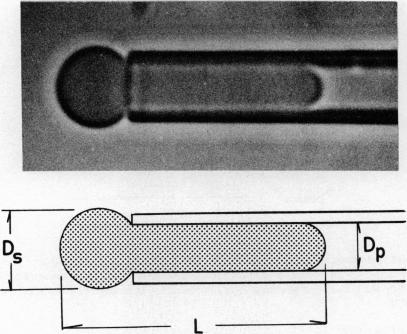
Previous work demonstrated that human red cells can be drawn into cylindrical glass micropipettes of internal diameter approximately 2.0 mum without lysing. For pipettes of less than approximately 2.9 mum inside diameter, the red cell must become less spherical, that is, reduce its volume-to-area ratio. In this work measurements were made from 16-mm film records that allowed the determination of the cellular area and volume of individual erythrocytes as they were drawn into a 2.0-mum pipette with negative pressures. The results showed that the total surface area of the membrane remains constant and that the cell endures the passage into the pipette by losing volume. The volume loss was interpreted to be due to cell water and solute loss when the membrane is under stress. The loss of cell volume, rather than the stretching of the membrane, adds confirmation that although it is very deformable, the membrane is very resistant to two-dimensional strain.
先前的研究表明,人类红细胞可以被吸入内径约为2.0微米的圆柱形玻璃微量移液器中而不会裂解。对于内径小于约2.9微米的移液器,红细胞必须变得不那么呈球形,也就是说,降低其体积与面积之比。在这项研究中,通过16毫米胶片记录进行测量,从而能够确定单个红细胞在负压作用下被吸入2.0微米移液器时的细胞面积和体积。结果表明,细胞膜的总表面积保持不变,并且细胞通过减少体积来承受进入移液器的过程。体积减少被解释为是由于膜受到应力时细胞内水分和溶质的流失。细胞体积的减少,而非膜的拉伸,进一步证实了尽管细胞膜非常易变形,但它对二维应变具有很强的抵抗力。