McVey D, Ray S, Gluzman Y, Berger L, Wildeman A G, Marshak D R, Tegtmeyer P
Department of Microbiology, State University of New York, Stony Brook 11794.
J Virol. 1993 Sep;67(9):5206-15. doi: 10.1128/JVI.67.9.5206-5215.1993.
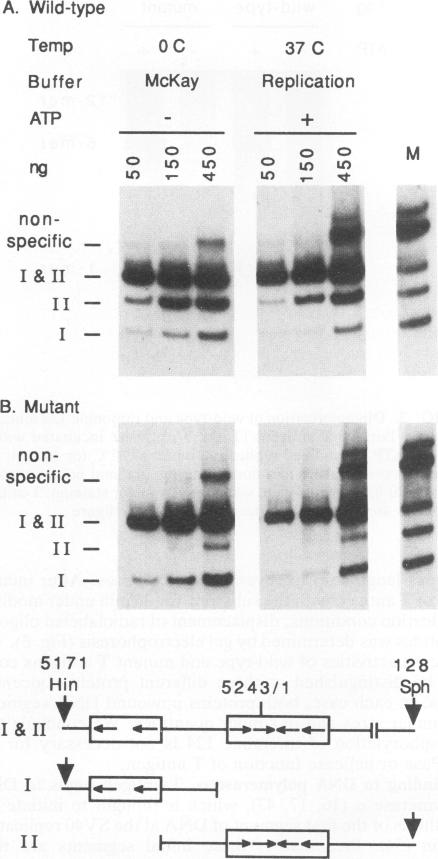
Phosphorylation of simian virus 40 (SV40) T antigen on threonine 124 activates viral DNA replication in vivo and in vitro. We have manipulated the modification of T-antigen residue 124 both genetically and biochemically and have investigated individual replication functions of T antigen under conditions suitable for in vitro DNA replication. We find that the hexamer assembly, helicase, DNA polymerase alpha-binding, and transcriptional-autoregulation functions are independent of phosphorylation of threonine 124. In contrast, neither T antigen with an alanine mutation of threonine 124 made in human cells nor unphosphorylated T antigen made in Escherichia coli binds the SV40 replication origin as stably as phosphorylated wild-type T antigen does. Furthermore, modification of threonine 124 is essential for complete unwinding of the SV40 replication origin. We conclude that phosphorylation of threonine 124 enhances specific interactions of T antigen with SV40 origin DNA. Our findings do not exclude the possibility that phosphorylation of threonine 124 may affect additional undefined steps in DNA replication. We also show that DNase footprinting and KMnO4 modification assays are not as stringent as immunoprecipitation and origin-dependent strand displacement assays for detecting defects in the origin-binding and -unwinding functions of T antigen. Differences in the assays may explain discrepancies in previous reports on the role of T-antigen phosphorylation in DNA binding.
猴病毒40(SV40)T抗原的苏氨酸124位点磷酸化在体内和体外均可激活病毒DNA复制。我们通过遗传学和生物化学方法对T抗原124位残基的修饰进行了调控,并在适合体外DNA复制的条件下研究了T抗原的各个复制功能。我们发现六聚体组装、解旋酶、DNA聚合酶α结合和转录自调控功能均不依赖于苏氨酸124的磷酸化。相比之下,在人细胞中产生的苏氨酸124位点丙氨酸突变的T抗原以及在大肠杆菌中产生的未磷酸化T抗原,与SV40复制起点的结合都不如磷酸化的野生型T抗原稳定。此外,苏氨酸124的修饰对于SV40复制起点的完全解旋至关重要。我们得出结论,苏氨酸124的磷酸化增强了T抗原与SV40起点DNA的特异性相互作用。我们的发现并不排除苏氨酸124磷酸化可能影响DNA复制中其他未明确步骤的可能性。我们还表明,在检测T抗原的起点结合和解旋功能缺陷方面,DNase足迹法和KMnO4修饰法不如免疫沉淀法和依赖起点的链置换法严格。这些检测方法的差异可能解释了先前关于T抗原磷酸化在DNA结合中作用的报道存在的差异。