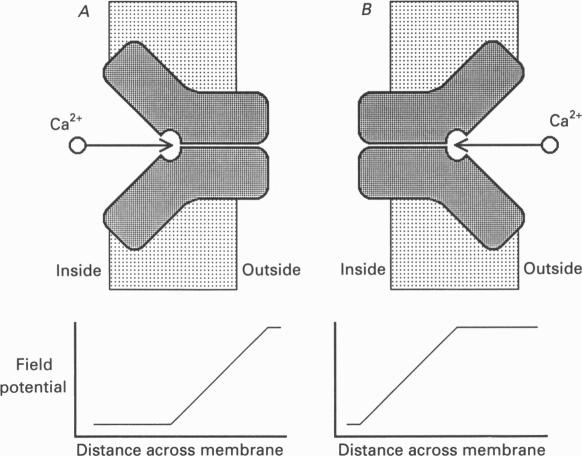
Membrane currents caused by the operation of electrogenic Na(+)-Ca2+,K+ exchange were recorded from isolated rod outer segments under voltage-clamp using a whole-cell electrode. 2. Reversed mode exchange currents (Na+i-Ca2+o,K+o) were recorded with a high internal [Na+] and when both Ca2+ and K+ were present in the external solution. Omission of either Ca2+ or K+ completely suppressed both the reversed exchange current and the entry of Ca2+. 3. The charge transferred by the exchange per Ca2+ ion transported was identical in both forward and reversed modes. 4. The reversed exchange current declined as Ca2+ accumulated inside the outer segment, and the form of this decline was consistent with a first-order inhibition by internal Ca2+. 5. The reversed exchange current was increased e-fold by a 230 mV depolarization over the range -51 to +29 mV. 6. The activation of reversed exchange by external Ca2+ was well described by first-order kinetics with a Michaelis constant, KappCao, of 34 microM in the presence of 20 mM external K+. KappCao was reduced by lowering external [K+], was increased by adding external Na+ and was unaffected by membrane potential. 7. External K+ also activated the exchange in a first-order manner with a Michaelis constant, KappKo, of 151 microM in the presence of 0.5 mM external Ca2+. KappKo was reduced by lowering external [Ca2+], increased by adding external Na+ and was unaffected by membrane potential. 8. When the level of internal Ca2+ was increased via reversed exchange, KappCao diminished in proportion to the reduction in the maximum current, but KappKo remained approximately constant. 9. These observations cannot be reconciled with simple models of the exchange in which ions bind simultaneously at opposite faces of the membrane before transport occurs. The results are broadly consistent with a consecutive model of the exchange in which unbinding of Na+ at either the external or the internal membrane surface is followed by binding of Ca2+ and then K+, and are fully reproduced by a model in which Ca2+ binds before all of the Na+ has dissociated from the exchange molecule.