Ralston R, Thudium K, Berger K, Kuo C, Gervase B, Hall J, Selby M, Kuo G, Houghton M, Choo Q L
Chiron Corporation, Emeryville, California 94608.
J Virol. 1993 Nov;67(11):6753-61. doi: 10.1128/JVI.67.11.6753-6761.1993.
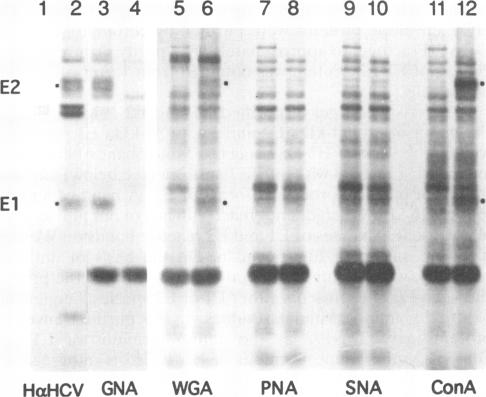
We constructed recombinant vaccinia virus vectors for expression of the structural region of hepatitis C virus (HCV). Infection of mammalian cells with a vector (vv/HCV1-906) encoding C-E1-E2-NS2 generated major protein species of 22 kDa (C), 33 to 35 kDa (E1), and 70 to 72 kDa (E2), as observed previously with other mammalian expression systems. The bulk of the E1 and E2 expressed by vv/HCV1-906 was found integrated into endoplasmic reticulum membranes as core-glycosylated species, suggesting that these E1 and E2 species represent intracellular forms of the HCV envelope proteins. HCV E1 and E2 formed E1-E2 complexes which were precipitated by either anti-E1 or anti-E2 serum and which sedimented at approximately 15 S on glycerol density gradients. No evidence of intermolecular disulfide bonding between E1 and E2 was detected. E1 and E2 were copurified to approximately 90% purity by mild detergent extraction followed by chromatography on Galanthus nivalus lectin-agarose and DEAE-Fractogel. Immunization of chimpanzees with purified E1-E2 generated high titers of anti-E1 and anti-E2 antibodies. Further studies, to be reported separately, demonstrated that purified E1-E2 complexes were recognized at high frequency by HCV+ human sera (D. Y. Chien, Q.-L. Choo, R. Ralston, R. Spaete, M. Tong, M. Houghton, and G. Kuo, Lancet, in press) and generated protective immunity in chimpanzees (Q.-L. Choo, G. Kuo, R. Ralston, A. Weiner, D. Chien, G. Van Nest, J. Han, K. Berger, K. Thudium, J. Kansopon, J. McFarland, A. Tabrizi, K. Ching, B. Mass, L. B. Cummins, E. Muchmore, and M. Houghton, submitted for publication), suggesting that these purified HCV envelope proteins display native HCV epitopes.
我们构建了用于表达丙型肝炎病毒(HCV)结构区的重组痘苗病毒载体。用编码C-E1-E2-NS2的载体(vv/HCV1-906)感染哺乳动物细胞,产生了分子量分别为22 kDa(C)、33至35 kDa(E1)和70至72 kDa(E2)的主要蛋白种类,正如之前在其他哺乳动物表达系统中所观察到的那样。发现由vv/HCV1-906表达的大部分E1和E2以核心糖基化形式整合到内质网膜中,这表明这些E1和E2种类代表HCV包膜蛋白的细胞内形式。HCV E1和E2形成了E1-E2复合物,该复合物可被抗E1或抗E2血清沉淀,并且在甘油密度梯度上以约15 S沉降。未检测到E1和E2之间分子间二硫键的证据。通过温和的去污剂提取,然后在雪花莲凝集素-琼脂糖和DEAE-弗拉克托凝胶上进行层析,E1和E2被共纯化至纯度约为90%。用纯化的E1-E2免疫黑猩猩产生了高滴度的抗E1和抗E2抗体。将另行报道的进一步研究表明,纯化的E1-E2复合物被HCV阳性人血清高频识别(D.Y. Chien、Q.-L. Choo、R. Ralston、R. Spaete、M. Tong、M. Houghton和G. Kuo,《柳叶刀》,即将发表),并在黑猩猩中产生保护性免疫(Q.-L. Choo、G. Kuo、R. Ralston、A. Weiner、D. Chien、G. Van Nest、J. Han、K. Berger、K. Thudium、J. Kansopon、J. McFarland、A. Tabrizi、K. Ching,B. Mass、L.B. Cummins、E. Muchmore和M. Houghton,已提交发表),这表明这些纯化的HCV包膜蛋白展示了天然的HCV表位。