Sundquist W I, Heaphy S
Department of Biochemistry, University of Utah, Salt Lake City 84132.
Proc Natl Acad Sci U S A. 1993 Apr 15;90(8):3393-7. doi: 10.1073/pnas.90.8.3393.
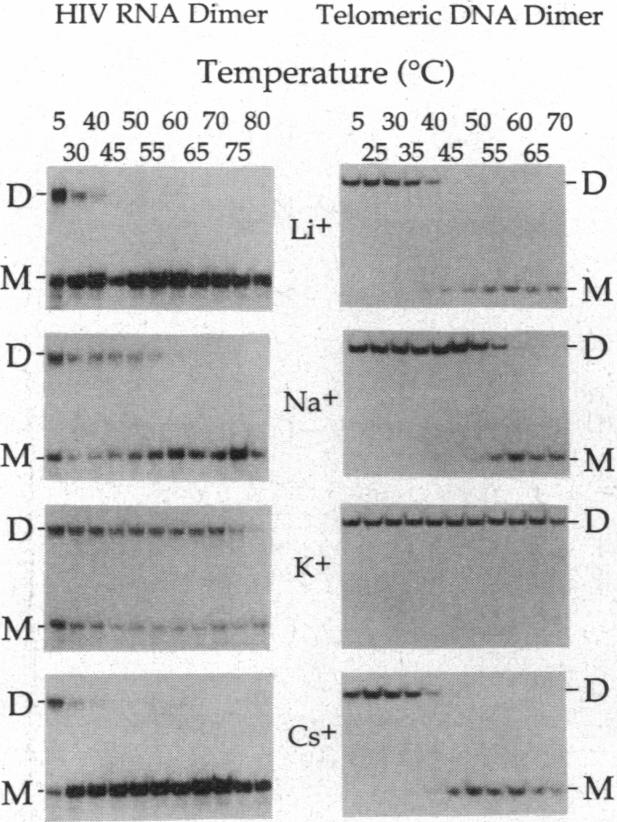
Retroviruses package two homologous single-stranded RNA genomes within a gag protein-RNA complex. In mature virion particles, the two RNA strands are thought to associate primarily through direct RNA-RNA interactions, although the structural basis for this stable association is unknown. We now report that a 127-nucleotide (nt) HIV-1NL4-3 RNA fragment (positions 732-858) encompassing the 5' end of the gag gene dimerizes spontaneously under high ionic strength conditions in the absence of any protein cofactor. The HIV-1 RNA dimer is dramatically and specifically stabilized by the monovalent cation potassium. Thermal dissociation of the dimer occurs at 80 degrees C in 100 mM K+ (5 mM Mg2+) but at significantly lower temperatures in the presence of either smaller or larger monovalent cations (100 mM Li+, 40 degrees C; 100 mM Na+, 55 degrees C; 100 mM Cs+, 30 degrees C). Deletion analyses of the 3' end of the 127-nt fragment reveal that an HIV-1 RNA fragment as short as 94 nt (732-825) can dimerize spontaneously, but a further 9-base deletion of the purine-rich sequence, GGGGGAGAA from positions 817 through 825, eliminates dimerization. These experimental results support a model in which HIV-1 RNA dimerizes by forming an interstrand quadruple helix stabilized by guanine (and/or purine)-base tetrads in analogy to the well-known dimerization of telomeric DNA. We speculate that this structure may also mediate the association of genomic HIV-1 RNA in vivo, revealing how RNA itself can achieve the self-recognition required for subsequent genetic recombination.
逆转录病毒在一个gag蛋白-RNA复合物中包裹两个同源单链RNA基因组。在成熟的病毒粒子中,两条RNA链被认为主要通过直接的RNA-RNA相互作用结合在一起,尽管这种稳定结合的结构基础尚不清楚。我们现在报告,一个包含gag基因5'端的127个核苷酸(nt)的HIV-1 NL4-3 RNA片段(位置732-858)在没有任何蛋白质辅助因子的情况下,在高离子强度条件下会自发二聚化。HIV-1 RNA二聚体通过单价阳离子钾显著且特异性地稳定。在100 mM K+(5 mM Mg2+)中,二聚体的热解离发生在80℃,但在存在更小或更大的单价阳离子(100 mM Li+,40℃;100 mM Na+,55℃;100 mM Cs+,30℃)时,热解离温度明显更低。对127-nt片段3'端的缺失分析表明,一个短至94 nt(732-825)的HIV-1 RNA片段可以自发二聚化,但从位置817到825的富含嘌呤的序列GGG GGAGAA进一步缺失9个碱基后,二聚化消失。这些实验结果支持了一个模型,即HIV-1 RNA通过形成由鸟嘌呤(和/或嘌呤)碱基四重体稳定的链间四重螺旋而二聚化,这类似于端粒DNA的著名二聚化。我们推测这种结构也可能介导体内HIV-1基因组RNA的结合,揭示了RNA本身如何实现后续基因重组所需的自我识别。