Dreyfus G, Williams A W, Kawagishi I, Macnab R M
Department of Molecular Biophysics and Biochemistry, Yale University, New Haven, Connecticut 06511-8148.
J Bacteriol. 1993 May;175(10):3131-8. doi: 10.1128/jb.175.10.3131-3138.1993.
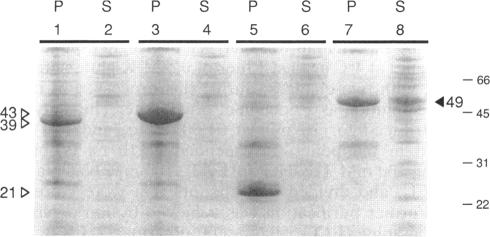
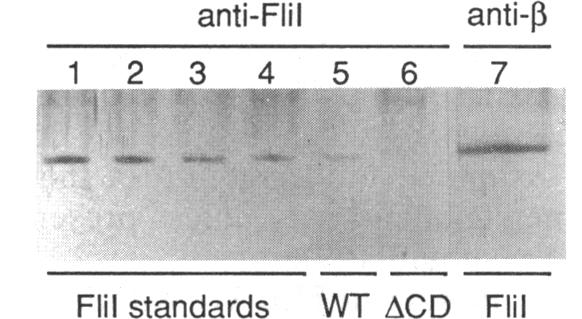
FliI is a Salmonella typhimurium protein that is needed for flagellar assembly and may be involved in a specialized protein export pathway that proceeds without signal peptide cleavage. FliI shows extensive sequence similarity to the catalytic beta subunit of the F0F1 ATPase (A. P. Volger, M. Homma, V. M. Irikura, and R. M. Macnab, J. Bacteriol. 173:3564-3572, 1991). It is even more similar to the Spa47 protein of Shigella flexneri (M. M. Venkatesan, J. M. Buysse, and E. V. Oaks, J. Bacteriol. 174:1990-2001, 1992) and the HrpB6 protein of Xanthomonas campestris (S. Fenselau, I. Balbo, and U. Bonas, Mol. Plant-Microbe Interact. 5:390-396, 1992), which are believed to play a role in the export of virulence proteins. Site-directed mutagenesis of residues in FliI that correspond to catalytically important residues in the F1 beta subunit resulted in loss of flagellation, supporting the hypothesis that FliI is an ATPase. FliI was overproduced and purified almost to homogeneity. It demonstrated ATP binding but not hydrolysis. An antibody raised against FliI permitted detection of the protein in wild-type cells and an estimate of about 1,500 subunits per cell. An antibody directed against the F1 beta subunit of Escherichia coli cross-reacted with FliI, confirming that the proteins are structurally related. The relationship between three proteins involved in flagellar assembly (FliI, FlhA, and FliP) and homologs in a variety of virulence systems is discussed.
FliI是鼠伤寒沙门氏菌中的一种蛋白质,鞭毛组装需要该蛋白质,它可能参与一种无需信号肽切割的特殊蛋白质输出途径。FliI与F0F1 ATP酶的催化β亚基具有广泛的序列相似性(A.P.沃尔格、M.本间、V.M.伊里库拉和R.M.麦克纳布,《细菌学杂志》173:3564 - 3572,1991年)。它与福氏志贺氏菌的Spa47蛋白(M.M.文卡特桑、J.M.布伊斯和E.V.奥克斯,《细菌学杂志》174:1990 - 2001,1992年)以及野油菜黄单胞菌的HrpB6蛋白(S.芬塞劳、I.巴尔博和U.博纳斯,《分子植物 - 微生物相互作用》5:390 - 396,1992年)更为相似,据信这些蛋白在毒力蛋白的输出中发挥作用。对FliI中与F1β亚基中具有催化重要性的残基相对应的残基进行定点诱变,导致失去鞭毛形成能力,支持了FliI是一种ATP酶的假说。FliI被过量表达并纯化至几乎均一。它表现出ATP结合但不水解。针对FliI产生的抗体能够在野生型细胞中检测到该蛋白,估计每个细胞约有1500个亚基。针对大肠杆菌F1β亚基的抗体与FliI发生交叉反应,证实这些蛋白在结构上相关。本文还讨论了参与鞭毛组装的三种蛋白质(FliI、FlhA和FliP)与各种毒力系统中的同源物之间的关系。