Yuen K Y, Chan C M, Chan K S, Yam W C, Ho P L, Chau P Y
Department of Microbiology, University of Hong Kong, Hong Kong.
J Clin Pathol. 1995 Oct;48(10):924-8. doi: 10.1136/jcp.48.10.924.
To evaluate the usefulness of two IS6110 based typing methods, an amplityping assay and restriction fragment length polymorphism (RFLP) analysis, for fingerprinting respiratory isolates of Mycobacterium tuberculosis.
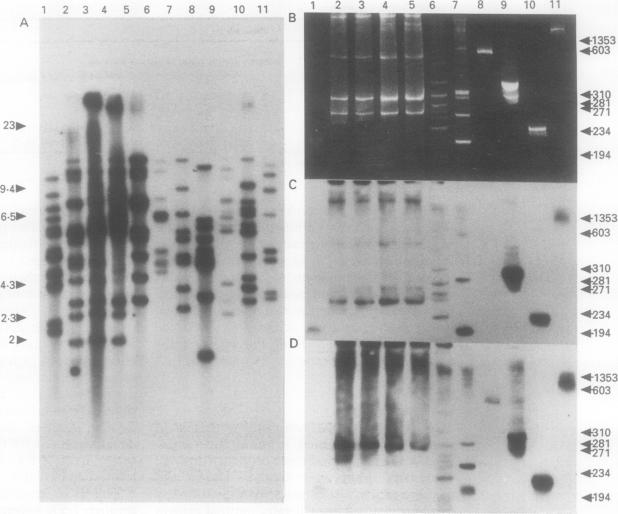
For amplityping, a pair of primers which amplify the intervening sequence between the repetitive insertion sequence IS6110 was used to generate a banding pattern which was confirmed by hybridisation. This assay was compared with conventional chromosomal DNA RFLP typing in the evaluation of 110 epidemiologically diverse isolates.
Polymerase chain reaction (PCR) amplityping generated a single pattern in Hong Kong Chinese strains, but two and four diverse patterns in Filipino and Vietnamese strains, respectively, and could be completed within four days. When compared with chromosomal DNA RFLP typing, which took three weeks to complete, four different RFLP patterns could be seen among the Chinese strains, while seven patterns were found in the Filipino and Vietnamese strains. No change in amplityping or RFLP patterns was found in 36 sequential isolates from the same patients after anti-tuberculosis treatment for up to 12 months, despite the emergence of resistance in three of these strains. No specific amplityping or RFLP pattern could be related to different patterns of drug susceptibility.
PCR amplityping could be used initially as a rapid typing method to distinguish strains originating from different localities. This could be important for investigation of outbreaks of tuberculosis--for example, in refugee camps.
评估两种基于IS6110的分型方法,即扩增分型试验和限制性片段长度多态性(RFLP)分析,用于结核分枝杆菌呼吸道分离株指纹图谱分析的实用性。
对于扩增分型,使用一对引物扩增重复插入序列IS6110之间的间隔序列,以产生通过杂交确认的条带模式。在对110株流行病学上不同的分离株进行评估时,将该试验与传统的染色体DNA RFLP分型进行比较。
聚合酶链反应(PCR)扩增分型在香港华人菌株中产生单一模式,但在菲律宾人和越南人菌株中分别产生两种和四种不同模式,并且可以在四天内完成。与需要三周时间完成的染色体DNA RFLP分型相比,华人菌株中可观察到四种不同的RFLP模式,而在菲律宾人和越南人菌株中发现七种模式。在同一患者的36株连续分离株中,经过长达12个月的抗结核治疗后,尽管其中三株出现耐药性,但扩增分型或RFLP模式均未发现变化。没有特定的扩增分型或RFLP模式与不同的药物敏感性模式相关。
PCR扩增分型最初可用作快速分型方法,以区分来自不同地区的菌株。这对于结核病暴发调查可能很重要,例如在难民营中。