Holliday R, McFarland G A
CSIRO Division of Biomolecular Engineering, Sydney Laboratory, NSW, Australia.
Br J Cancer. 1996 Apr;73(8):966-71. doi: 10.1038/bjc.1996.189.
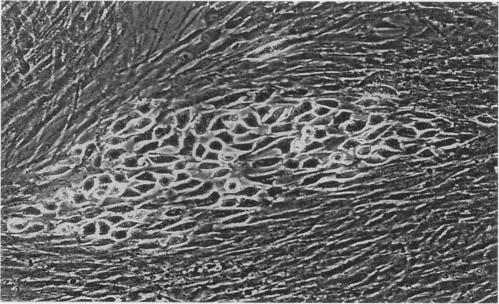
Human diploid fibroblasts growth normally in medium containing physiological concentrations of the naturally occurring dipeptide carnosine (beta-alanyl-L-histidine). These concentrations are cytotoxic to transformed and neoplastic cells lines in modified Eagle medium (MEM), whereas these cells grow vigorously in Dulbecco's modified Eagle medium (DMEM) containing carnosine. This difference is due to the presence of 1 mM sodium pyruvate in DMEM. Seven human cell lines and two rodent cell lines were tested and all are strongly inhibited by carnosine in the absence of pyruvate. Experiments with HeLa cells show that anserine is similar to carnosine, but D-carnosine and homocarnosine are without effect. Also, the non-essential amino acids alanine and glutamic acid contribute to the effect of pyruvate in preventing carnosine toxicity, and oxaloacetate and alpha-ketoglutarate can substitute for pyruvate. We have used mixtures of normal MRC-5 fibroblasts and HeLa cells to demonstrate that 20 mM carnosine can selectively eliminate the tumour cells. This has obvious implications which might be exploited in in vivo and in vitro studies. Carnosine is known to react strongly with aldehyde and keto groups of sugars by Amadori reaction, and we propose that it depletes certain glycolysis intermediates. It is well known that tumour cells are more dependent on glycolysis than normal cells. A reduction of glycolysis intermediates by carnosine may deplete their energy supply, but this effect is totally reversed by pyruvate.
人二倍体成纤维细胞在含有生理浓度天然存在的二肽肌肽(β-丙氨酰-L-组氨酸)的培养基中正常生长。这些浓度对改良伊格尔培养基(MEM)中的转化细胞系和肿瘤细胞系具有细胞毒性,而这些细胞在含有肌肽的杜尔贝科改良伊格尔培养基(DMEM)中生长旺盛。这种差异是由于DMEM中存在1 mM丙酮酸钠。测试了七种人类细胞系和两种啮齿动物细胞系,在没有丙酮酸钠的情况下,所有细胞系均受到肌肽的强烈抑制。对HeLa细胞的实验表明,鹅肌肽与肌肽相似,但D-肌肽和高肌肽没有作用。此外,非必需氨基酸丙氨酸和谷氨酸有助于丙酮酸钠预防肌肽毒性的作用,草酰乙酸和α-酮戊二酸可以替代丙酮酸钠。我们使用正常的MRC-5成纤维细胞和HeLa细胞的混合物来证明20 mM肌肽可以选择性地消除肿瘤细胞。这具有明显的意义,可能在体内和体外研究中得到利用。已知肌肽通过阿马多里反应与糖的醛基和酮基发生强烈反应,我们认为它会消耗某些糖酵解中间体。众所周知,肿瘤细胞比正常细胞更依赖糖酵解。肌肽减少糖酵解中间体会耗尽它们的能量供应,但这种作用会被丙酮酸钠完全逆转。