Wang W W, Shahrestanifar M, Jin J, Howells R D
Department of Biochemistry and Molecular Biology, New Jersey Medical School, Newark 07103, USA.
Proc Natl Acad Sci U S A. 1995 Dec 19;92(26):12436-40. doi: 10.1073/pnas.92.26.12436.
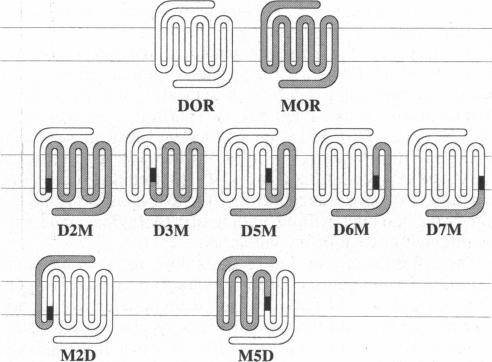
Opioid receptors are members of the guanine nucleotide binding protein (G protein)-coupled receptor family. Three types of opioid receptors have been cloned and characterized and are referred to as the delta, kappa and mu types. Analysis of receptor chimeras and site-directed mutant receptors has provided a great deal of information about functionally important amino acid side chains that constitute the ligand-binding domains and G-protein-coupling domains of G-protein-coupled receptors. We have constructed delta/mu opioid receptor chimeras that were express in human embryonic kidney 293 cells in order to define receptor domains that are responsible for receptor type selectivity. All chimeric receptors and wild-type delta and mu opioid receptors displayed high-affinity binding of etorphine (an agonist), naloxone (an antagonist), and bremazocine (a mixed agonist/antagonist). In contrast, chimeras that lacked the putative first extracellular loop of the mu receptor did not bind the mu-selective peptide [D-Ala2,MePhe4,Gly5-ol]enkephalin (DAMGO). Chimeras that lacked the putative third extracellular loop of the delta receptor did not bind the delta-selective peptide, [D-Ser2,D-Leu5]enkephalin-Thr (DSLET). Point mutations in the putative third extracellular loop of the wild-type delta receptor that converted vicinal arginine residues to glutamine abolished DSLET binding while not affecting bremazocine, etorphine, and naltrindole binding. We conclude that amino acids in the putative first extracellular loop of the mu receptor are critical for high-affinity DAMGO binding and that arginine residues in the putative third extracellular loop of the delta receptor are important for high-affinity DSLET binding.
阿片受体是鸟嘌呤核苷酸结合蛋白(G蛋白)偶联受体家族的成员。已克隆并鉴定出三种类型的阿片受体,分别称为δ、κ和μ型。对受体嵌合体和定点突变受体的分析提供了大量有关构成G蛋白偶联受体配体结合域和G蛋白偶联域的功能重要氨基酸侧链的信息。我们构建了在人胚肾293细胞中表达的δ/μ阿片受体嵌合体,以确定负责受体类型选择性的受体结构域。所有嵌合受体以及野生型δ和μ阿片受体均显示出对埃托啡(一种激动剂)、纳洛酮(一种拮抗剂)和布马佐辛(一种混合激动剂/拮抗剂)的高亲和力结合。相比之下,缺乏μ受体假定的第一个细胞外环的嵌合体不结合μ选择性肽[D-Ala2,MePhe4,Gly5-ol]脑啡肽(DAMGO)。缺乏δ受体假定的第三个细胞外环的嵌合体不结合δ选择性肽[D-Ser2,D-Leu5]脑啡肽-苏氨酸(DSLET)。野生型δ受体假定的第三个细胞外环中的点突变将相邻的精氨酸残基转化为谷氨酰胺,消除了DSLET结合,同时不影响布马佐辛、埃托啡和纳曲吲哚的结合。我们得出结论,μ受体假定的第一个细胞外环中的氨基酸对于高亲和力DAMGO结合至关重要,而δ受体假定的第三个细胞外环中的精氨酸残基对于高亲和力DSLET结合很重要。