Dong S, Zhu J, Reid A, Strutt P, Guidez F, Zhong H J, Wang Z Y, Licht J, Waxman S, Chomienne C, Chen Z, Zelent A, Chen S J
Laboratory of Molecular Biology, Shanghai Institute of Hematology, Shanghai Second Medical University (SSMU) Peoples Republic of China.
Proc Natl Acad Sci U S A. 1996 Apr 16;93(8):3624-9. doi: 10.1073/pnas.93.8.3624.
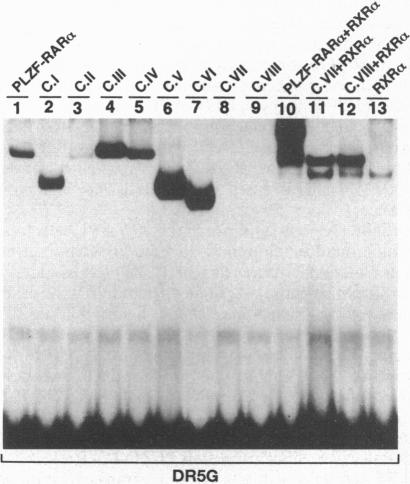
Promyelocytic leukemia zinc finger-retinoic acid receptor a (PLZF-RARalpha), a fusion receptor generated as a result of a variant t(11;17) chromosomal translocation that occurs in a small subset of acute promyelocytic leukemia (APL) patients, has been shown to display a dominant-negative effect against the wild-type RARalpha/retinoid X receptor alpha (RXRalpha). We now show that its N-terminal region (called the POZ-domain), which mediates protein-protein interaction as well as specific nuclear localization of the wild-type PLZF and chimeric PLZF-RARalpha proteins, is primarily responsible for this activity. To further investigate the mechanisms of PLZF-RARalpha action, we have also studied its ligand-receptor, protein-protein, and protein-DNA interaction properties and compared them with those of the promyelocytic leukemia gene (PML)-RARalpha, which is expressed in the majority of APLs as a result of t(15;17) translocation. PLZF-RARalpha and PML-RARalpha have essentially the same ligand-binding affinities and can bind in vitro to retinoic acid response elements (RAREs) as homodimers or heterodimers with RXRalpha. PLZF-RARalpha homodimerization and heterodimerization with RXRalpha were primarily mediated by the POZ-domain and RARalpha sequence, respectively. Despite having identical RARalpha sequences, PLZF-RARalpha and PML-RARalpha homodimers recognized with different affinities distinct RAREs. Furthermore, PLZF-RARalpha could heterodimerize in vitro with the wild-type PLZF, suggesting that it may play a role in leukemogenesis by antagonizing actions of not only the retinoid receptors but also the wild-type PLZF and possibly other POZ-domain-containing regulators. These different protein-protein interactions and the target gene specificities of PLZF-RARalpha and PML-RARalpha may underlie, at least in part, the apparent resistance of APL with t(11;17) to differentiation effects of all-trans-retinoic acid.
早幼粒细胞白血病锌指 - 视黄酸受体α(PLZF - RARα)是一种融合受体,由一小部分急性早幼粒细胞白血病(APL)患者中发生的变异t(11;17)染色体易位产生,已显示出对野生型RARα/视黄酸X受体α(RXRα)具有显性负效应。我们现在表明,其N端区域(称为POZ结构域)介导蛋白质 - 蛋白质相互作用以及野生型PLZF和嵌合PLZF - RARα蛋白的特定核定位,主要负责这种活性。为了进一步研究PLZF - RARα的作用机制,我们还研究了其配体 - 受体、蛋白质 - 蛋白质和蛋白质 - DNA相互作用特性,并将它们与早幼粒细胞白血病基因(PML) - RARα的特性进行了比较,PML - RARα由于t(15;17)易位而在大多数APL中表达。PLZF - RARα和PML - RARα具有基本相同 的配体结合亲和力,并且在体外可以作为同二聚体或与RXRα的异二聚体结合到视黄酸反应元件(RAREs)上。PLZF - RARα同二聚化以及与RXRα的异二聚化分别主要由POZ结构域和RARα序列介导。尽管具有相同的RARα序列,但PLZF - RARα和PML - RARα同二聚体以不同亲和力识别不同的RAREs。此外,PLZF - RARα在体外可以与野生型PLZF异二聚化,这表明它可能不仅通过拮抗类视黄醇受体的作用,还通过拮抗野生型PLZF以及可能其他含POZ结构域的调节因子的作用,在白血病发生中发挥作用。PLZF - RARα和PML - RARα的这些不同蛋白质 - 蛋白质相互作用和靶基因特异性可能至少部分地解释了具有t(11;17)的APL对全反式维甲酸分化作用的明显抗性。