Jovanovic J N, Benfenati F, Siow Y L, Sihra T S, Sanghera J S, Pelech S L, Greengard P, Czernik A J
Laboratory of Molecular and Cellular Neuroscience, The Rockefeller University, New York, NY 10021-6399, USA.
Proc Natl Acad Sci U S A. 1996 Apr 16;93(8):3679-83. doi: 10.1073/pnas.93.8.3679.
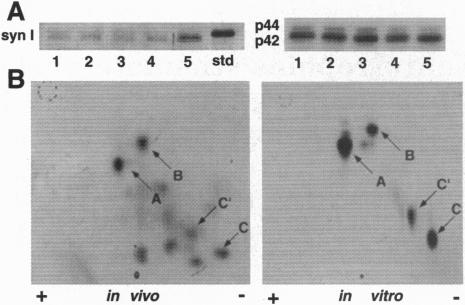
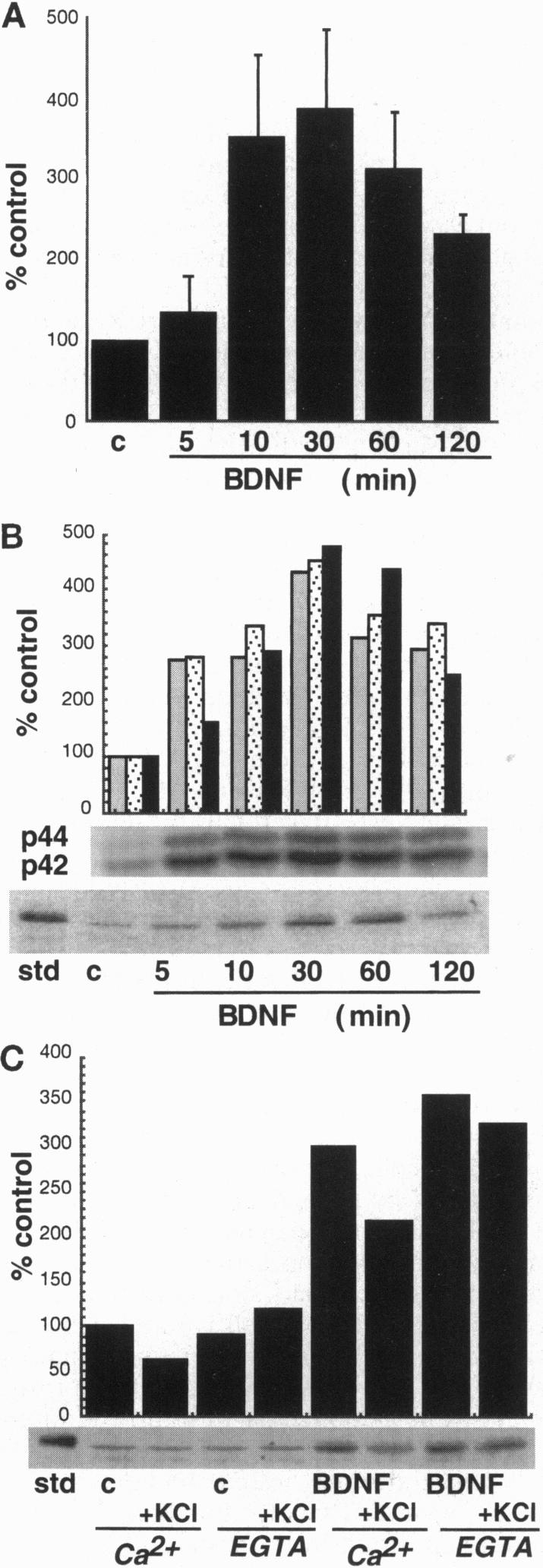
The ability of neurotrophins to modulate the survival and differentiation of neuronal populations involves the Trk/MAP (mitogen-activated protein kinase) kinase signaling pathway. More recently, neurotrophins have also been shown to regulate synaptic transmission. The synapsins are a family of neuron-specific phosphoproteins that play a role in regulation of neurotransmitter release, in axonal elongation, and in formation and maintenance of synaptic contacts. We report here that synapsin I is a downstream effector for the neurotrophin/Trk/MAP kinase cascade. Using purified components, we show that MAP kinase stoichiometrically phosphorylated synapsin I at three sites (Ser-62, Ser-67, and Ser-549). Phosphorylation of these sites was detected in rat brain homogenates, in cultured cerebrocortical neurons, and in isolated presynaptic terminals. Brain-derived neurotrophic factor and nerve growth factor upregulated phosphorylation of synapsin I at MAP kinase-dependent sites in intact cerebrocortical neurons and PC12 cells, respectively, while KCl- induced depolarization of cultured neurons decreased the phosphorylation state at these sites. MAP kinase-dependent phosphorylation of synapsin I significantly reduced its ability to promote G-actin polymerization and to bundle actin filaments. The results suggest that MAP kinase-dependent phosphorylation of synapsin I may contribute to the modulation of synaptic plasticity by neurotrophins and by other signaling pathways that converge at the level of MAP kinase activation.
神经营养因子调节神经元群体存活和分化的能力涉及Trk/丝裂原活化蛋白(MAP)激酶信号通路。最近,神经营养因子还被证明可调节突触传递。突触素是一类神经元特异性磷蛋白家族,在神经递质释放调节、轴突伸长以及突触接触的形成和维持中发挥作用。我们在此报告,突触素I是神经营养因子/Trk/MAP激酶级联反应的下游效应器。使用纯化的成分,我们表明MAP激酶以化学计量方式在三个位点(Ser-62、Ser-67和Ser-549)磷酸化突触素I。在大鼠脑匀浆、培养的大脑皮质神经元和分离的突触前终末中均检测到这些位点的磷酸化。脑源性神经营养因子和神经生长因子分别上调完整大脑皮质神经元和PC12细胞中MAP激酶依赖性位点的突触素I磷酸化,而KCl诱导的培养神经元去极化降低了这些位点的磷酸化状态。MAP激酶依赖性的突触素I磷酸化显著降低了其促进G-肌动蛋白聚合和肌动蛋白丝成束的能力。结果表明,MAP激酶依赖性的突触素I磷酸化可能有助于神经营养因子以及在MAP激酶激活水平汇聚的其他信号通路对突触可塑性的调节。