Schwarz J M, Neese R A, Turner S, Dare D, Hellerstein M K
Department of Nutritional Sciences, University of California, Berkeley 94720-3104, USA.
J Clin Invest. 1995 Dec;96(6):2735-43. doi: 10.1172/JCI118342.
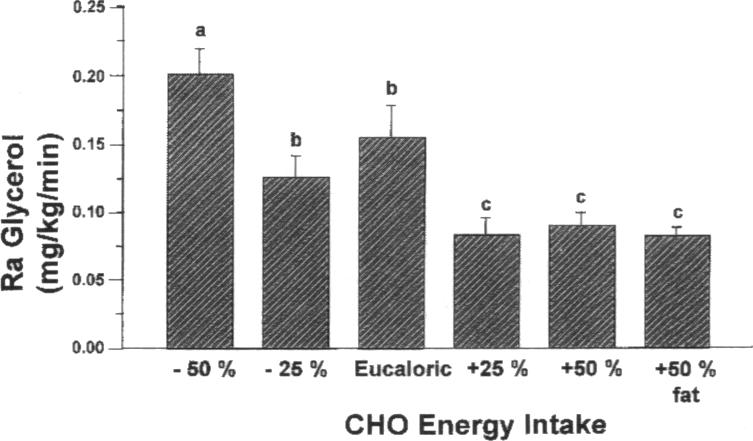
Short-term alterations in dietary carbohydrate (CHO) energy are known to alter whole-body fuel selection in humans, but the metabolic mechanisms remain unknown. We used stable isotope-mass spectrometric methods with indirect calorimetry in normal subjects to quantify the metabolic response to six dietary phases (5 d each), ranging from 50% surplus CHO (+50% CHO) to 50% deficient CHO (-50% CHO), and 50% surplus fat (+50% fat). Fasting hepatic glucose production (HGP) varied by > 40% from deficient to surplus CHO diets (1.78 +/- 0.08 vs 2.43 +/- 0.09 mg/kg per min, P < 0.01). Increased HGP on surplus CHO occurred despite significantly higher serum insulin concentrations. Lipolysis correlated inversely with CHO intake as did the proportion of whole-body lipolytic flux oxidized. Fractional de novo hepatic lipogenesis (DNL) increased more than 10-fold on surplus CHO and was unmeasurable on deficient CHO diets; thus, the preceding 5-d CHO intake could be inferred from DNL. Nevertheless, absolute hepatic DNL accounted for < 5g fatty acids synthesized per day even on +50% CHO. Whole-body CHO oxidation increased sixfold and fat oxidation decreased > 90% on surplus CHO diets. CHO oxidation was highly correlated with HGP (r2= 0.60). HGP could account for 85% of fasting CHO oxidation on +25% CHO and 67% on +50% CHO diets. Some oxidation of intracellular CHO stores was therefore also occurring. +50% fat diet had no effects on HGP, DNL, or fuel selection. We conclude that altered CHO intake alters HGP specifically and in a dose-dependent manner, that HGP may mediate the effects of CHO on whole-body fuel selection both by providing substrate and by altering serum insulin concentrations, that altered lipolysis and tissue oxidation efficiency contribute to changes in fat oxidation, and that surplus CHO is not substantially converted by the liver to fat as it spares fat oxidation, but that fractional DNL may nevertheless be a qualitative marker of recent CHO intake.
已知饮食中碳水化合物(CHO)能量的短期变化会改变人体全身的燃料选择,但其代谢机制仍不清楚。我们在正常受试者中使用稳定同位素质谱法结合间接量热法,以量化对六个饮食阶段(每个阶段5天)的代谢反应,这些阶段从50%碳水化合物过剩(+50% CHO)到50%碳水化合物缺乏(-50% CHO),以及50%脂肪过剩(+50%脂肪)。从碳水化合物缺乏饮食到过剩饮食,空腹肝葡萄糖生成(HGP)变化超过40%(分别为1.78±0.08与2.43±0.09毫克/千克每分钟,P<0.01)。尽管血清胰岛素浓度显著升高,但碳水化合物过剩时HGP仍增加。脂肪分解与CHO摄入量呈负相关,全身脂肪分解通量的氧化比例也是如此。在碳水化合物过剩时,肝脏从头脂肪生成(DNL)分数增加超过10倍,而在碳水化合物缺乏饮食中无法测量;因此,可从DNL推断前5天的CHO摄入量。然而,即使在+50% CHO时,肝脏绝对DNL每天合成的脂肪酸也不到5克。在碳水化合物过剩饮食中,全身CHO氧化增加6倍,脂肪氧化减少>90%。CHO氧化与HGP高度相关(r2 = 0.60)。在+25% CHO饮食中,HGP可解释空腹CHO氧化的85%,在+50% CHO饮食中为67%。因此,细胞内CHO储备也存在一些氧化。+50%脂肪饮食对HGP、DNL或燃料选择没有影响。我们得出结论,CHO摄入量的改变会特异性地且以剂量依赖的方式改变HGP,HGP可能通过提供底物和改变血清胰岛素浓度来介导CHO对全身燃料选择的影响,脂肪分解和组织氧化效率的改变导致脂肪氧化的变化,并且过剩的CHO不会被肝脏大量转化为脂肪因为它节省了脂肪氧化,但DNL分数可能仍然是近期CHO摄入量的定性标志物。