Bullard D C, Scharffetter-Kochanek K, McArthur M J, Chosay J G, McBride M E, Montgomery C A, Beaudet A L
Department of Molecular, Baylor College of Medicine, Houston, TX 77030, USA.
Proc Natl Acad Sci U S A. 1996 Mar 5;93(5):2116-21. doi: 10.1073/pnas.93.5.2116.
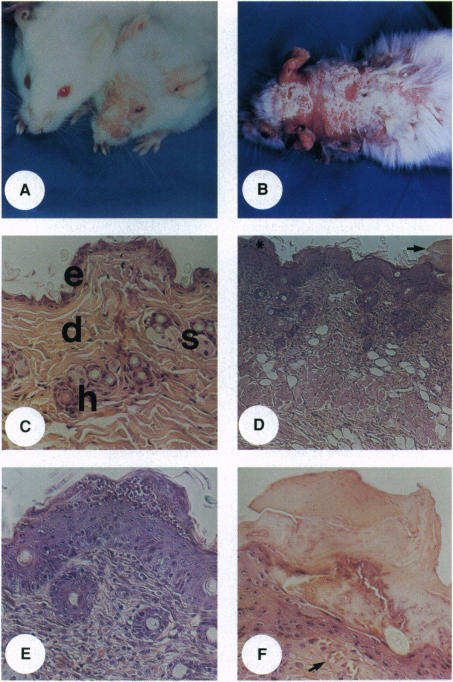
Previously, a hypomorphic mutation in CD18 was generated by gene targeting, with homozygous mice displaying increased circulating neutrophil counts, defects in the response to chemically induced peritonitis, and delays in transplantation rejection. When this mutation was backcrossed onto the PL/J inbred strain, virtually all homozygous mice developed a chronic inflammatory skin disease with a mean age of onset of 11 weeks after birth. The disease was characterized by erythema, hair loss, and the development of scales and crusts. The histopathology revealed hyperplasia of the epidermis, subcorneal microabscesses, orthohyperkeratosis, parakeratosis, and lymphocyte exocytosis, which are features in common with human psoriasis and other hyperproliferative inflammatory skin disorders. Repetitive cultures failed to demonstrate bacterial or fungal organisms potentially involved in the pathogenesis of this disease, and the dermatitis resolved rapidly after subcutaneous administration of dexamethasone. Homozygous mutant mice on a (PL/J x C57BL/6J)F1 background did not develop the disease and backcross experiments suggest that a small number of genes (perhaps as few as one), in addition to CD18, determine susceptibility to the disorder. This phenotype provides a model for inflammatory skin disorders, may have general relevance to polygenic human inflammatory diseases, and should help to identify genes that interact with the beta2 integrins in inflammatory processes.
此前,通过基因靶向技术产生了CD18的低表达突变,纯合小鼠表现出循环中性粒细胞计数增加、对化学诱导的腹膜炎反应存在缺陷以及移植排斥反应延迟。当该突变回交到PL/J近交系时,几乎所有纯合小鼠都患上了一种慢性炎症性皮肤病,平均发病年龄为出生后11周。该疾病的特征为红斑、脱发以及鳞屑和结痂的形成。组织病理学显示表皮增生、角质层下微脓肿、正角化过度、角化不全以及淋巴细胞外渗,这些都是人类银屑病和其他增殖性炎症性皮肤病的共同特征。反复培养未能证明该疾病发病机制中可能涉及的细菌或真菌,皮下注射地塞米松后皮炎迅速消退。(PL/J×C57BL/6J)F1背景的纯合突变小鼠未患该疾病,回交实验表明,除了CD18外,少数基因(可能少至一个)决定了对该疾病的易感性。这种表型为炎症性皮肤病提供了一个模型,可能与多基因人类炎症性疾病普遍相关,并且应该有助于识别在炎症过程中与β2整合素相互作用的基因。