Zhu Z Y, Karlin S
Department of Mathematics, Stanford University, CA 94305-2125, USA.
Proc Natl Acad Sci U S A. 1996 Aug 6;93(16):8350-5. doi: 10.1073/pnas.93.16.8350.
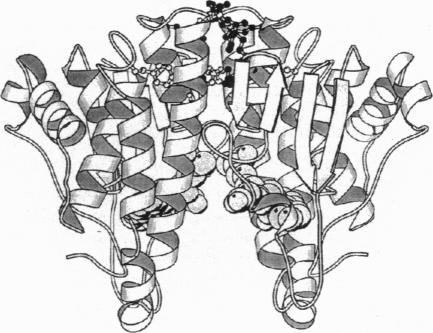
Statistically significant charge clusters (basic, acidic, or of mixed charge) in tertiary protein structures are identified by new methods from a large representative collection of protein structures. About 10% of protein structures show at least one charge cluster, mostly of mixed type involving about equally anionic and cationic residues. Positive charge clusters are very rare. Negative (or histidine-acidic) charge clusters often coordinate calcium, or magnesium or zinc ions [e.g., thermolysin (PDB code: 3tln), mannose-binding protein (2msb), aminopeptidase (1amp)]. Mixed-charge clusters are prominent at interchain contacts where they stabilize quaternary protein formation [e.g., glutathione S-transferase (2gst), catalase (8act), and fructose-1,6-bisphosphate aldolase (1fba)]. They are also involved in protein-protein interaction and in substrate binding. For example, the mixed-charge cluster of aspartate carbamoyl-transferase (8atc) envelops the aspartate carbonyl substrate in a flexible manner (alternating tense and relaxed states) where charge associations can vary from weak to strong. Other proteins with charge clusters include the P450 cytochrome family (BM-3, Terp, Cam), several flavocytochromes, neuraminidase, hemagglutinin, the photosynthetic reaction center, and annexin. In each case in Table 2 we discuss the possible role of the charge clusters with respect to protein structure and function.
通过新方法从大量具有代表性的蛋白质结构集合中识别出三级蛋白质结构中具有统计学意义的电荷簇(碱性、酸性或混合电荷)。约10%的蛋白质结构显示至少一个电荷簇,大多为混合型,阴离子和阳离子残基数量大致相等。正电荷簇非常罕见。负(或组氨酸-酸性)电荷簇常与钙、镁或锌离子配位[例如,嗜热菌蛋白酶(PDB代码:3tln)、甘露糖结合蛋白(2msb)、氨肽酶(1amp)]。混合电荷簇在链间接触处很突出,它们稳定蛋白质四级结构的形成[例如,谷胱甘肽S-转移酶(2gst)、过氧化氢酶(8act)和果糖-1,6-二磷酸醛缩酶(1fba)]。它们还参与蛋白质-蛋白质相互作用和底物结合。例如,天冬氨酸氨甲酰基转移酶(8atc)的混合电荷簇以灵活的方式(交替处于紧张和松弛状态)包裹天冬氨酸羰基底物,电荷关联强度可从弱到强变化。其他具有电荷簇的蛋白质包括P450细胞色素家族(BM-3、Terp、Cam)、几种黄素细胞色素、神经氨酸酶、血凝素、光合反应中心和膜联蛋白。在表2的每种情况下,我们都讨论了电荷簇在蛋白质结构和功能方面可能发挥的作用。