Henderson R M, Schneider S, Li Q, Hornby D, White S J, Oberleithner H
Department of Pharmacology, University of Cambridge, United Kingdom.
Proc Natl Acad Sci U S A. 1996 Aug 6;93(16):8756-60. doi: 10.1073/pnas.93.16.8756.
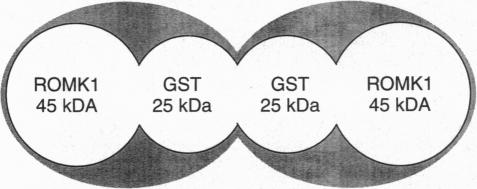
The inwardly rectifying K+ channel ROMK1 has been implicated as being significant in K+ secretion in the distal nephron. ROMK1 has been shown by immunocytochemistry to be expressed in relevant nephron segments. The development of the atomic force microscope has made possible the production of high resolution images of small particles, including a variety of biological macromolecules. Recently, a fusion protein of glutathione S-transferase (GST) and ROMK1 (ROMK1-GST) has been used to produce a polyclonal antibody for immunolocalization of ROMK1. We have used atomic force microscopy to examine ROMK1-GST and the native ROMK1 polypeptide cleaved from GST. Imaging was conducted with the proteins in physiological solutions attached to mica. ROMK1-GST appears in images as a particle composed of two units of similar size. Analyses of images indicate that the two units have volumes of approximately 118 nm3, which is close to the theoretical volume of a globular protein of approximately 65 kDa (the molecular mass of ROMK1-GST). Native GST exists as a dimer, and the images obtained here are consistent with the ROMK1-GST fusion protein's existence as a heterodimer. In experiments on ROMK1 in aqueous solution, single molecules appear to aggregate, but contact to the mica was maintained. Addition of ATP to the solution produced a change in height of the aggregates. This change (which was reversible) suggests that ATP induces a structural change in the ROMK1 protein. The data show that atomic force microscopy is a useful tool for examination of purified protein molecules under near-physiological conditions, and furthermore, that structural alterations in the proteins may be continuously investigated.
内向整流钾通道ROMK1被认为在远端肾单位的钾分泌中起重要作用。免疫细胞化学显示ROMK1在相关肾单位节段中表达。原子力显微镜的发展使得生成包括各种生物大分子在内的小颗粒的高分辨率图像成为可能。最近,谷胱甘肽S-转移酶(GST)与ROMK1的融合蛋白(ROMK1-GST)已被用于制备用于ROMK1免疫定位的多克隆抗体。我们使用原子力显微镜检查ROMK1-GST和从GST切割下来的天然ROMK1多肽。在附着于云母的生理溶液中对蛋白质进行成像。ROMK1-GST在图像中表现为一个由两个大小相似的单元组成的颗粒。图像分析表明,这两个单元的体积约为118 nm³,接近约65 kDa(ROMK1-GST的分子量)球形蛋白的理论体积。天然GST以二聚体形式存在,此处获得的图像与ROMK1-GST融合蛋白作为异二聚体的存在一致。在水溶液中对ROMK1进行的实验中,单分子似乎会聚集,但与云母的接触得以维持。向溶液中添加ATP会使聚集体的高度发生变化。这种变化(是可逆的)表明ATP诱导了ROMK1蛋白的结构变化。数据表明,原子力显微镜是在接近生理条件下检查纯化蛋白质分子的有用工具,此外,还可以持续研究蛋白质中的结构改变。