Smith T L, Sauer R T
Department of Biology, Massachusetts Institute of Technology, Cambridge 02139-4703, USA.
Proc Natl Acad Sci U S A. 1996 Aug 20;93(17):8868-72. doi: 10.1073/pnas.93.17.8868.
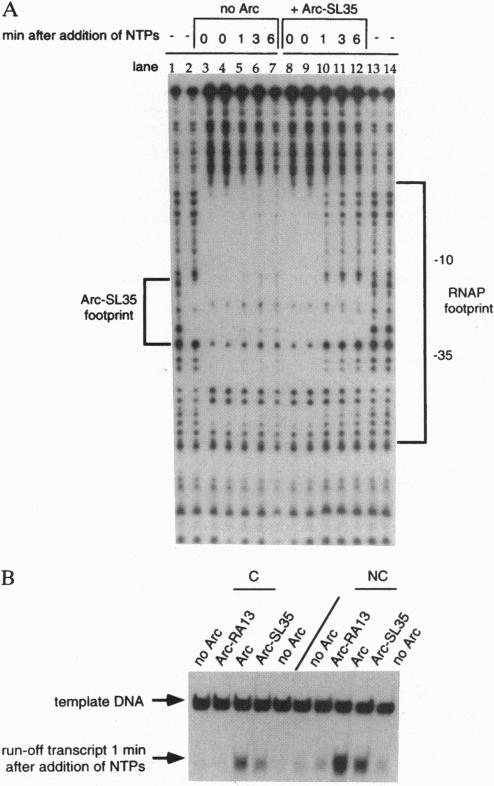
In studies of variants of the P(ant) promoter of bacteriophage P22, the Arc protein was found not only to slow the rate at which RNA polymerase forms open complexes but also to accelerate the rate at which the enzyme clears the promoter. These dual activities permit Arc, bound at a single operator subsite, to act as an activator or as a repressor of different promoter variants. For example, Arc activates a P(ant) variant for which promoter clearance is rate limiting in the presence and absence of Arc but represses a closely related variant for which open-complex formation becomes rate limiting in the presence of Arc. The acceleration of promoter clearance by Arc requires occupancy of the operator subsite proximal to the -35 region and is diminished when Arc bears a mutation in Arg-23, a residue that makes a DNA-backbone contact in the operator complex.
在对噬菌体P22的P(ant)启动子变体的研究中,发现Arc蛋白不仅会减缓RNA聚合酶形成开放复合物的速率,还会加速该酶离开启动子的速率。这些双重活性使得结合在单个操纵子亚位点上的Arc能够作为不同启动子变体的激活剂或抑制剂。例如,Arc激活一种P(ant)变体,在有或没有Arc的情况下,该变体的启动子清除是限速步骤;但Arc抑制一种密切相关的变体,在有Arc的情况下,该变体的开放复合物形成成为限速步骤。Arc对启动子清除的加速需要占据靠近 -35区域的操纵子亚位点,当Arc的精氨酸-23发生突变时,这种加速作用会减弱,精氨酸-23是在操纵子复合物中与DNA主链接触的一个残基。