Silva A M, Lee A Y, Gulnik S V, Maier P, Collins J, Bhat T N, Collins P J, Cachau R E, Luker K E, Gluzman I Y, Francis S E, Oksman A, Goldberg D E, Erickson J W
Structural Biochemistry Program, National Cancer Institute/SAIC, Frederick, MD 21702, USA.
Proc Natl Acad Sci U S A. 1996 Sep 17;93(19):10034-9. doi: 10.1073/pnas.93.19.10034.
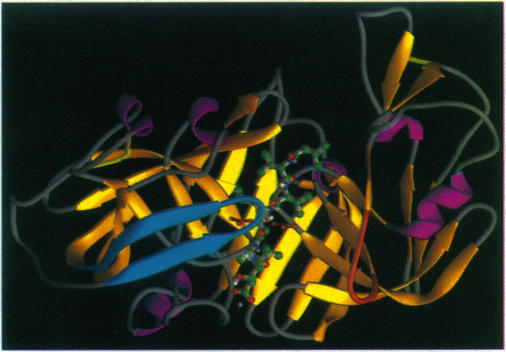
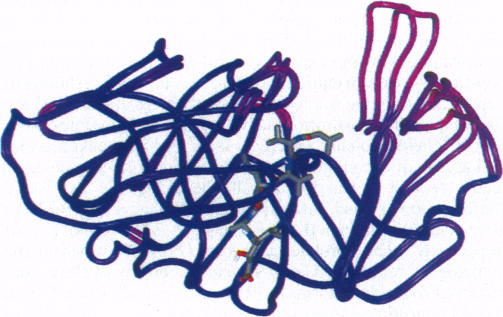
Plasmodium falciparum is the major causative agent of malaria, a disease of worldwide importance. Resistance to current drugs such as chloroquine and mefloquine is spreading at an alarming rate, and our antimalarial armamentarium is almost depleted. The malarial parasite encodes two homologous aspartic proteases, plasmepsins I and II, which are essential components of its hemoglobin-degradation pathway and are novel targets for antimalarial drug development. We have determined the crystal structure of recombinant plasmepsin II complexed with pepstatin A. This represents the first reported crystal structure of a protein from P. falciparum. The crystals contain molecules in two different conformations, revealing a remarkable degree of interdomain flexibility of the enzyme. The structure was used to design a series of selective low molecular weight compounds that inhibit both plasmepsin II and the growth of P. falciparum in culture.
恶性疟原虫是疟疾的主要病原体,疟疾是一种具有全球重要性的疾病。对氯喹和甲氟喹等现有药物的耐药性正以惊人的速度蔓延,我们的抗疟药物储备几乎枯竭。疟原虫编码两种同源天冬氨酸蛋白酶,即疟原虫天冬氨酸蛋白酶I和II,它们是其血红蛋白降解途径的重要组成部分,也是抗疟药物开发的新靶点。我们已经确定了与胃蛋白酶抑制剂A复合的重组疟原虫天冬氨酸蛋白酶II的晶体结构。这是首次报道的来自恶性疟原虫的蛋白质晶体结构。晶体包含处于两种不同构象的分子,揭示了该酶显著程度的结构域间灵活性。该结构被用于设计一系列选择性低分子量化合物,这些化合物可抑制疟原虫天冬氨酸蛋白酶II以及培养物中恶性疟原虫的生长。