Chung C Y, Murphy-Ullrich J E, Erickson H P
Department of Cell Biology, Duke University Medical Center, Durham, North Carolina 27710, USA.
Mol Biol Cell. 1996 Jun;7(6):883-92. doi: 10.1091/mbc.7.6.883.
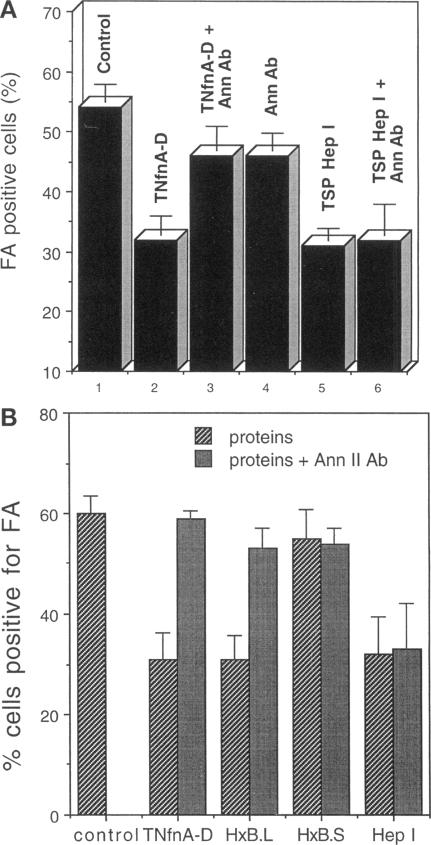
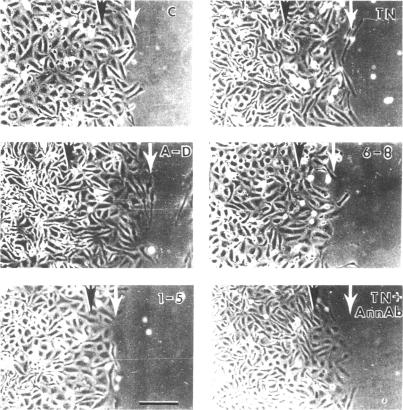
In a previous study we demonstrated that the alternatively spliced region of tenascin-C, TNfnA-D, bound with high affinity to a cell surface receptor, annexin II. In the present study we demonstrate three changes in cellular activity that are produced by adding intact tenascin-C or TNfnA-D to cells, and we show that all three activities are blocked by antibodies against annexin II. 1) TNfnA-D added to confluent endothelial cells induced loss of focal adhesions. 2) TNfnA-D produced a mitogenic response of confluent, growth-arrested endothelial cells in 1% serum. TNfnA-D stimulated mitogenesis only when it was added to cells before or during exposure to other mitogens, such as basic fibroblast growth factor or serum. Thus the effect of TNfnA-D seems to be to facilitate the subsequent response to growth factors. 3) TNfnA-D enhanced cell migration in a cell culture wound assay. Antibodies to annexin II blocked all three cellular responses to TNfnA-D. These data show that annexin II receptors on endothelial cells mediate several cell regulatory functions attributed to tenascin-C, potentially through modulation of intracellular signalling pathways.
在之前的一项研究中,我们证明了腱生蛋白-C的可变剪接区域TNfnA-D与细胞表面受体膜联蛋白II具有高亲和力结合。在本研究中,我们证明了向细胞中添加完整的腱生蛋白-C或TNfnA-D会产生细胞活性的三种变化,并且我们表明所有这三种活性都被抗膜联蛋白II的抗体所阻断。1)添加到汇合内皮细胞中的TNfnA-D导致粘着斑丧失。2)TNfnA-D在1%血清中对汇合的、生长停滞的内皮细胞产生促有丝分裂反应。TNfnA-D仅在其在暴露于其他促有丝分裂原(如碱性成纤维细胞生长因子或血清)之前或期间添加到细胞时才刺激有丝分裂。因此,TNfnA-D的作用似乎是促进对生长因子的后续反应。3)在细胞培养伤口试验中,TNfnA-D增强了细胞迁移。抗膜联蛋白II的抗体阻断了对TNfnA-D的所有三种细胞反应。这些数据表明,内皮细胞上的膜联蛋白II受体可能通过调节细胞内信号通路介导了几种归因于腱生蛋白-C的细胞调节功能。