Swartz D R, Moss R L, Greaser M L
Department of Anatomy, Indiana University Medical School, Indianapolis 46202, USA.
Biophys J. 1996 Oct;71(4):1891-904. doi: 10.1016/S0006-3495(96)79388-8.
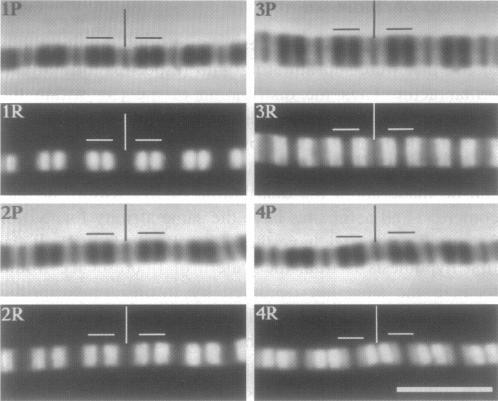
Skeletal muscle contraction is regulated by calcium via troponin and tropomyosin and appears to involve cooperative activation of cross-bridge binding to actin. We studied the regulation of fluorescent myosin subfragment 1 (fS1) binding to rigor myofibrils over a wide range of fS1 and calcium levels using highly sensitive imaging techniques. At low calcium and low fS1, the fluorescence was restricted to the actin-myosin overlap region. At high calcium and very low fS1, the fluorescence was still predominantly in the overlap region. The ratio of nonoverlap to overlap fluorescence intensity showed that increases in the fS1 level resulted in a shift in maximum fluorescence from the overlap to the nonoverlap region at both low and high calcium; this transition occurred at lower fS1 levels in myofibrils with high calcium. At a fixed fS1 level, increases in calcium also resulted in a shift in maximum fluorescence from the overlap region to the nonoverlap region. These results suggest that calcium alone does not fully activate the thin filament for rigor S1 binding and that, even at high calcium, the thin filament is not activated along its entire length.
骨骼肌收缩由钙通过肌钙蛋白和原肌球蛋白进行调节,并且似乎涉及横桥与肌动蛋白结合的协同激活。我们使用高灵敏度成像技术,在很宽的肌球蛋白亚片段1(fS1)和钙水平范围内,研究了荧光fS1与僵直肌原纤维结合的调节。在低钙和低fS1条件下,荧光局限于肌动蛋白 - 肌球蛋白重叠区域。在高钙和极低fS1条件下,荧光仍主要位于重叠区域。非重叠与重叠荧光强度的比值表明,fS1水平的增加导致在低钙和高钙条件下,最大荧光从重叠区域向非重叠区域偏移;在高钙的肌原纤维中,这种转变发生在较低的fS1水平。在固定的fS1水平下,钙的增加也导致最大荧光从重叠区域向非重叠区域偏移。这些结果表明,仅钙本身并不能完全激活细肌丝以实现与僵直S1的结合,并且即使在高钙条件下,细肌丝也并非沿其全长被激活。