Tienari P J, De Strooper B, Ikonen E, Simons M, Weidemann A, Czech C, Hartmann T, Ida N, Multhaup G, Masters C L, Van Leuven F, Beyreuther K, Dotti C G
Cell Biology Programme, European Molecular Biology Laboratories (EMBL), Heidelberg, Germany.
EMBO J. 1996 Oct 1;15(19):5218-29.
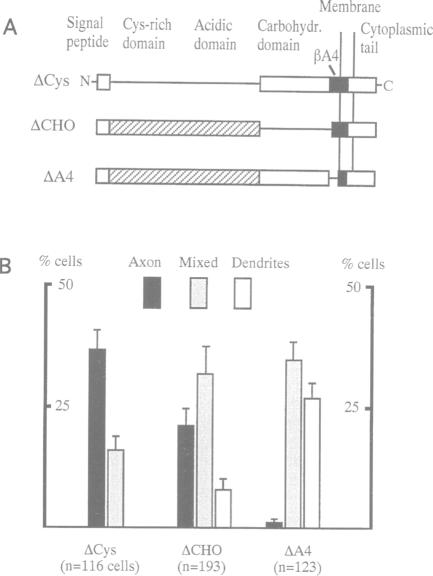
We have analysed the axonal sorting signals of amyloid precursor protein (APP). Wild-type and mutant versions of human APP were expressed in hippocampal neurons using the Semliki forest virus system. We show that wild-type APP and mutations implicated in Alzheimer's disease and another brain beta-amyloidosis are sorted to the axon. By analysis of deletion mutants we found that the membrane-inserted APP ectodomain but not the cytoplasmic tail is required for axonal sorting. Systematic deletions of the APP ectodomain identified two regions required for axonal delivery: one encoded by exons 11-15 in the carbohydrate domain, the other encoded by exons 16-17 in the juxtamembraneous beta-amyloid domain. Treatment of the cells with the N-glycosylation inhibitor tunicamycin induced missorting of wild-type APP, supporting the importance of glycosylation in axonal sorting of APP. The data revealed a hierarchy of sorting signals on APP: the beta-amyloid-dependent membrane proximal signal was the major contributor to axonal sorting, while N-glycosylation had a weaker effect. Furthermore, recessive somatodendritic signals, most likely in the cytoplasmic tail, directed the protein to the dendrites when the ectodomain was deleted. Analysis of detergent solubility of APP and another axonally delivered protein, hemagglutinin, demonstrated that only hemagglutinin formed CHAPS-insoluble complexes, suggesting distinct mechanisms of axonal sorting for these two proteins. This study is the first delineation of sorting requirements of an axonally targeted protein in polarized neurons and indicates that the beta-amyloid domain plays a major role in axonal delivery of APP.
我们分析了淀粉样前体蛋白(APP)的轴突分选信号。使用辛德毕斯病毒系统在海马神经元中表达了人APP的野生型和突变型。我们发现野生型APP以及与阿尔茨海默病和另一种脑β-淀粉样变性相关的突变体被分选到轴突。通过对缺失突变体的分析,我们发现轴突分选需要膜插入的APP胞外结构域而非胞质尾巴。对APP胞外结构域进行系统性缺失鉴定出了轴突运输所需的两个区域:一个由碳水化合物结构域中的外显子11 - 15编码,另一个由近膜β-淀粉样蛋白结构域中的外显子16 - 17编码。用N-糖基化抑制剂衣霉素处理细胞会导致野生型APP分选错误,这支持了糖基化在APP轴突分选中的重要性。数据揭示了APP上分选信号的层次结构:β-淀粉样蛋白依赖的膜近端信号是轴突分选的主要贡献者,而N-糖基化的作用较弱。此外,隐性的树突 - 体细胞信号(很可能在胞质尾巴中)在胞外结构域缺失时会将该蛋白导向树突。对APP和另一种轴突运输蛋白血凝素的去污剂溶解性分析表明,只有血凝素形成了不溶于CHAPS的复合物,这表明这两种蛋白的轴突分选机制不同。这项研究首次描绘了极化神经元中轴突靶向蛋白的分选要求,并表明β-淀粉样蛋白结构域在APP的轴突运输中起主要作用。