Nikkari S T, Höyhtyä M, Isola J, Nikkari T
Department of Medical Biochemistry, University of Tampere Medical School, Finland.
Am J Pathol. 1996 Nov;149(5):1427-33.
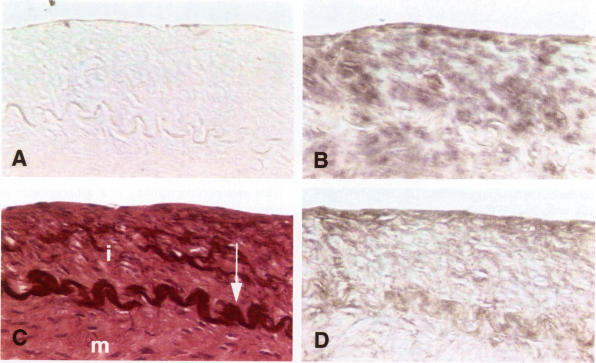
Inflammation precedes erosion and rupture of atherosclerotic atheromas and aneurysms. Inflammatory infiltrates of macrophages have been shown to secrete proteolytic enzymes, including matrix metalloproteinases (MMPs), that weaken the arterial wall. The effect of inflammation on arterial structure and remodeling can be studied in primary vascular inflammatory diseases such as in temporal arteritis. We examined the 72-kd gelatinase (MMP-2) and the 92-kd gelatinase (MMP-9) in inflamed and uninvolved temporal arteries from 10 patients with temporal arteritis and 5 controls by immunohistochemistry. The substrates of these enzymes, type IV collagen and elastin, were detected by immunohistochemistry and histochemical staining, respectively. Both diseased and normal artery specimens had moderate staining for immunoreactive MMP-2. Temporal arteritis specimens had clearly enhanced immunostaining for MMP-9 compared with normal arteries. MMP-9 was specifically localized to macrophages in regions of internal elastic lamina disruption, which may thus be of pathological significance.
炎症先于动脉粥样硬化斑块和动脉瘤的糜烂与破裂出现。巨噬细胞的炎性浸润已被证明会分泌包括基质金属蛋白酶(MMPs)在内的蛋白水解酶,这些酶会削弱动脉壁。炎症对动脉结构和重塑的影响可在原发性血管炎性疾病如颞动脉炎中进行研究。我们通过免疫组织化学检测了10例颞动脉炎患者和5例对照的发炎及未受累颞动脉中的72-kd明胶酶(MMP-2)和92-kd明胶酶(MMP-9)。这些酶的底物,IV型胶原和弹性蛋白,分别通过免疫组织化学和组织化学染色进行检测。患病和正常动脉标本对免疫反应性MMP-2均有中度染色。与正常动脉相比,颞动脉炎标本中MMP-9的免疫染色明显增强。MMP-9特异性定位于内弹性膜破坏区域的巨噬细胞,因此可能具有病理意义。