Endo H, Sasaki N, Yamagiwa D, Uetake Y, Kurohmaru M, Hayashi Y
Department of Zoology, National Science Museum, Tokyo, Japan.
J Anat. 1996 Dec;189 ( Pt 3)(Pt 3):587-92.
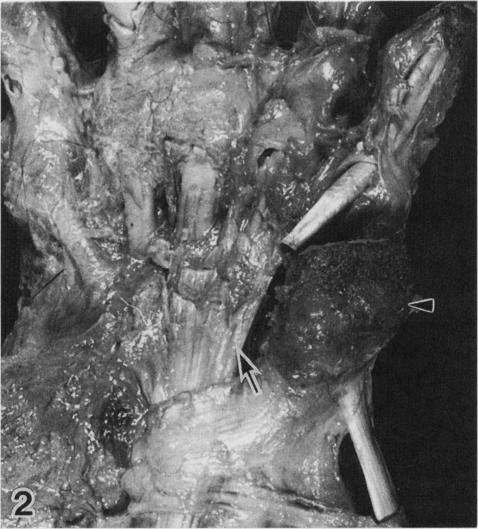
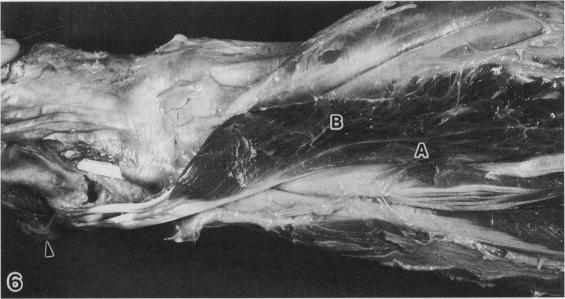
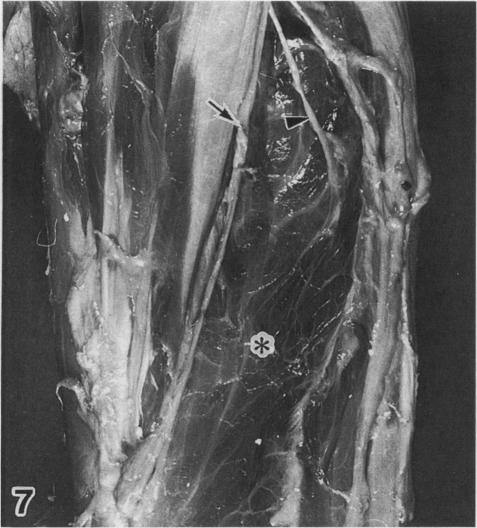
The function of the radial sesamoid bone (RS) in the giant panda (Ailuropoda melanoleuca) was examined by macroscopic study of RS-related bones and muscles. The RS was observed to be connected to the scapholunar and the 1st metacarpal bones. A joint cavity was present between the proximal surface of the RS and the distal area of the scapholunar bone but the RS possessed a fibrous joint connecting it to the proximal radial surface of the 1st metacarpal bone. It is suggested that the RS possesses no substantial abductor-adductor function as the articulation between the RS and the 1st metacarpal bone (FM) seems not to permit flexible movement of the RS. The RS may be a supporting process opposite the digits in the palm when the animal flexes its 5 digits to grip objects, but it is not an active grasping apparatus. In the muscular system, abductor pollicis longus provided strong tendons to the RS as an RS-abductor, whereas the abductor pollicis brevis, opponens pollicis and aponeurosis palmaris were well developed as an RS-adductor muscle group. Observation of RS articulations, however, showed that the muscles do not provide appreciable abduction-adduction actions for the RS.
通过对大熊猫(Ailuropoda melanoleuca)桡侧籽骨(RS)相关骨骼和肌肉的宏观研究,对其功能进行了检查。观察到RS与舟月骨和第一掌骨相连。在RS近端表面与舟月骨远端区域之间存在关节腔,但RS与第一掌骨近端桡侧表面之间有一个纤维关节相连。由于RS与第一掌骨(FM)之间的关节似乎不允许RS灵活移动,因此认为RS不具有实质性的外展-内收功能。当动物弯曲其5个手指抓握物体时,RS可能是手掌中与手指相对的一个支撑突起,但它不是一个主动抓握装置。在肌肉系统中,拇长展肌作为RS外展肌为RS提供了强大的肌腱,而拇短展肌、拇对掌肌和掌腱膜作为RS内收肌群发育良好。然而,对RS关节的观察表明,这些肌肉并未为RS提供明显的外展-内收动作。