Day I N, Haddad L, O'Dell S D, Day L B, Whittall R A, Humphries S E
Department of Medicine, The Rayne Institute, University College of London Medical School, UK.
J Med Genet. 1997 Feb;34(2):111-6. doi: 10.1136/jmg.34.2.111.
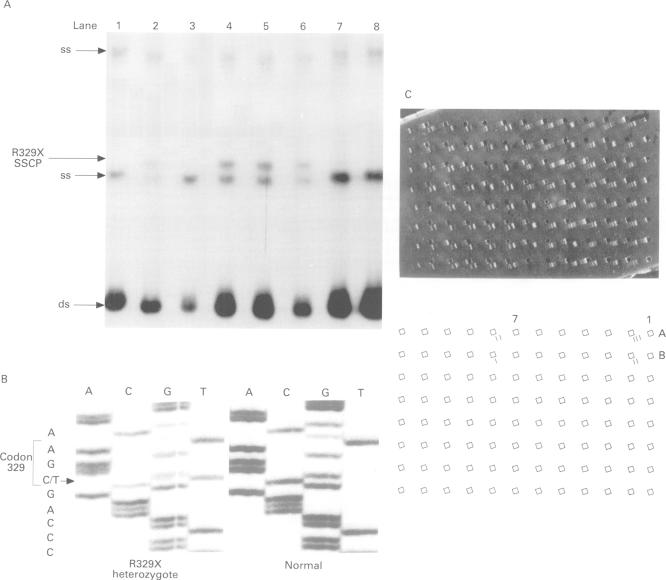
Familial hypercholesterolaemia is commonly caused by mutations in the low density lipoprotein receptor (LDLR) gene and more than 300 different mutations have been described worldwide. Some mutations occur at relatively higher frequency in certain populations, reflecting both chance and demography, most evident in founder populations. As part of a study of kindreds of 78 probands from Southampton and south west Hampshire, we identified the same mutation (R329X) in 9/78 (11.5%) probands. In all (100%) of these probands, length allele 259nt of the 17 allele microsatellite D19S394, sited approximately 250 kilobases telomeric and 5' to the LDLR gene, was observed, although in the general population this allele has a prevalence of only 16.1%. A simple diagnostic assay for R329X was constructed in conjunction with more detailed family studies. Both the R329X and linked D19S394 allele also cosegregated with the FH phenotype within each kindred. Although R329X involves a CpG site, it is highly likely that the families are identical by descent for R329X, we surmise with a common ancestor within 500 to 1000 years, although the mutation is not restricted to this geographical area. This relationship illustrates that the linkage disequilibrium of gene LDLR with marker D19S394 will enable rapid recognition using D19S394 genotype of possible common FH mutation(s) within a cohort of FH patients from a particular locality or ethnic group.
家族性高胆固醇血症通常由低密度脂蛋白受体(LDLR)基因突变引起,全球已描述了300多种不同的突变。某些突变在特定人群中出现的频率相对较高,这既反映了偶然性,也反映了人口统计学特征,在奠基者人群中最为明显。作为对来自南安普敦和汉普郡西南部的78名先证者亲属的研究的一部分,我们在9/78(11.5%)的先证者中发现了相同的突变(R329X)。在所有这些先证者(100%)中,均观察到位于LDLR基因端粒约250千碱基处且在其5'端的17等位基因微卫星D19S394的长度等位基因259nt,尽管在普通人群中该等位基因的患病率仅为16.1%。结合更详细的家族研究构建了一种针对R329X的简单诊断检测方法。R329X和连锁的D19S394等位基因在每个家族中也与FH表型共分离。尽管R329X涉及一个CpG位点,但很可能这些家族的R329X是同源的,我们推测其共同祖先在500至1000年内,尽管该突变并不局限于这一地理区域。这种关系表明,基因LDLR与标记D19S394的连锁不平衡将能够通过D19S394基因型快速识别来自特定地区或种族群体的FH患者队列中可能的常见FH突变。