Amara A, Gall S L, Schwartz O, Salamero J, Montes M, Loetscher P, Baggiolini M, Virelizier J L, Arenzana-Seisdedos F
Unité d'Immunologie Virale, Institut Pasteur, 75724 Paris, Cedex 15, France.
J Exp Med. 1997 Jul 7;186(1):139-46. doi: 10.1084/jem.186.1.139.
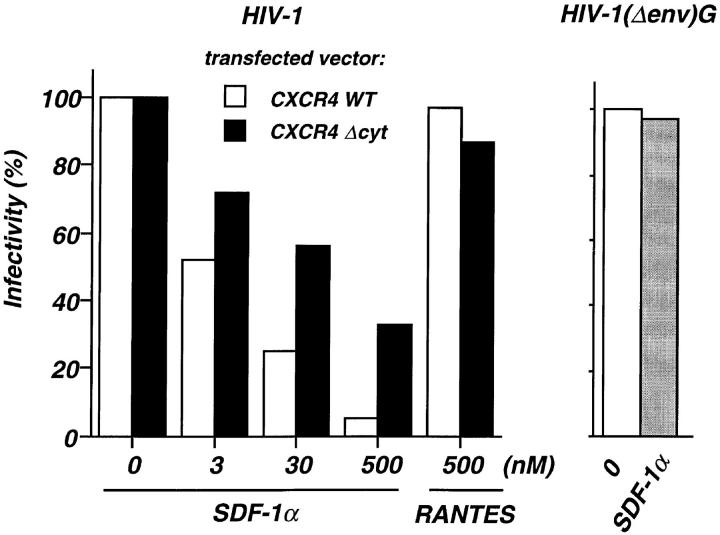
Ligation of CCR5 by the CC chemokines RANTES, MIP-1alpha or MIP-1beta, and of CXCR4 by the CXC chemokine SDF-1alpha, profoundly inhibits the replication of HIV strains that use these coreceptors for entry into CD4(+) T lymphocytes. The mechanism of entry inhibition is not known. We found a rapid and extensive downregulation of CXCR4 by SDF-1alpha and of CCR5 by RANTES or the antagonist RANTES(9-68). Confocal laser scanning microscopy showed that CCR5 and CXCR4, after binding to their ligands, are internalized into vesicles that qualify as early endosomes as indicated by colocalization with transferrin receptors. Internalization was not affected by treatment with Bordetella pertussis toxin, showing that it is independent of signaling via Gi-proteins. Removal of SDF-1alpha led to rapid, but incomplete surface reexpression of CXCR4, a process that was not inhibited by cycloheximide, suggesting that the coreceptor is recycling from the internalization pool. Deletion of the COOH-terminal, cytoplasmic domain of CXCR4 did not affect HIV entry, but prevented SDF-1alpha-induced receptor downregulation and decreased the potency of SDF-1alpha as inhibitor of HIV replication. Our results indicate that the ability of the coreceptor to internalize is not required for HIV entry, but contributes to the HIV suppressive effect of CXC and CC chemokines.
CC趋化因子RANTES、MIP-1α或MIP-1β对CCR5的结合,以及CXC趋化因子SDF-1α对CXCR4的结合,可显著抑制利用这些共受体进入CD4(+) T淋巴细胞的HIV毒株的复制。进入抑制的机制尚不清楚。我们发现SDF-1α可快速且广泛地下调CXCR4,RANTES或拮抗剂RANTES(9-68)可快速且广泛地下调CCR5。共聚焦激光扫描显微镜显示,CCR5和CXCR4与其配体结合后,会内化到囊泡中,通过与转铁蛋白受体共定位表明这些囊泡属于早期内体。内化不受百日咳博德特氏菌毒素处理的影响,表明其独立于通过Gi蛋白的信号传导。去除SDF-1α会导致CXCR4快速但不完全地重新表达于表面,这一过程不受放线菌酮抑制,提示共受体正从内化池中循环利用。缺失CXCR4的COOH末端胞质结构域不影响HIV进入,但可阻止SDF-1α诱导的受体下调,并降低SDF-1α作为HIV复制抑制剂的效力。我们的结果表明,共受体的内化能力并非HIV进入所必需,但有助于CXC和CC趋化因子的HIV抑制作用。