Seymour M T, Moskovic E C, Walsh G, Trott P, Smith I E
Department of Medicine, The Royal Marsden Hospital, London, UK.
Br J Cancer. 1997;76(3):371-6. doi: 10.1038/bjc.1997.392.
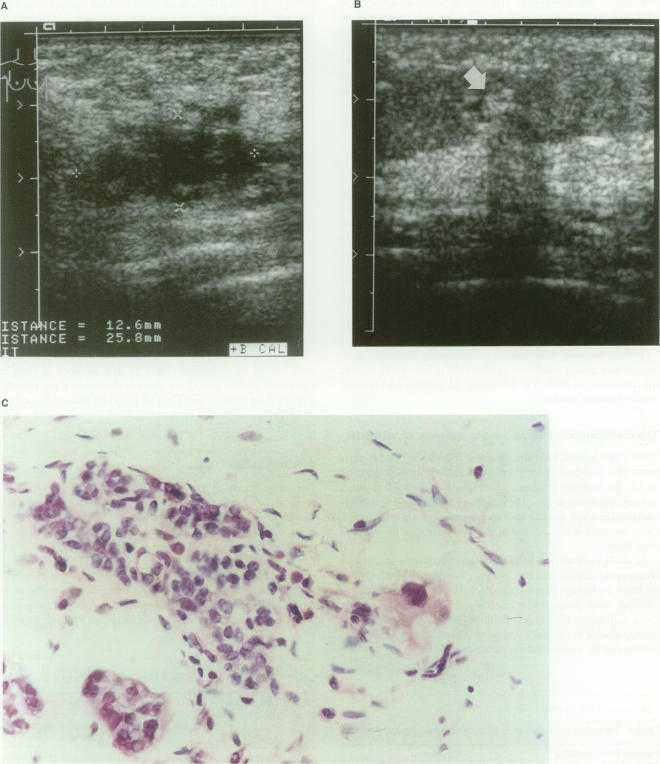
The purpose of this study was to assess the usefulness of ultrasonography (US) in the assessment of the breast following primary medical therapy (PMT) of large operable breast cancer. A total of 52 patients were studied; all had invasive breast cancer, confirmed by core biopsy, with initial size > 4 cm by palpation, T2-3, N0-1, M0. PMT was with epirubicin, cisplatin and continuous infusional 5-fluorouracil, as previously described (Jones et al, 1994, J Clin Oncol 12: 1259-1265). Independent clinical and US assessments were made during PMT before surgery or biopsy. A total of 31 (60%) patients achieved complete clinical response (cCR), but in only five of these was the post-treatment ultrasound normal. Post-treatment sonographic findings of diffuse parenchymal distortion or a mass lesion without Doppler signal were associated with more favourable histology (pathological CR, non-invasive or microinvasive carcinoma), whereas a mass with Doppler positivity was more often associated with residual macroscopic invasive carcinoma. Patients who did not achieve cCR had a high incidence of residual macroscopic carcinoma (71%) regardless of the sonographic characteristics. With median follow-up of 27 months (range 12-43), ten (19%) patients have relapsed and six (12%) have died, but only one relapse has occurred within treated breast. Ultrasonography is a sensitive technique for assessing the response to PMT, particularly in patients who achieve cCR. It may be helpful in selecting those patients who do not require post-PMT surgery and in localizing abnormalities in those who do, particularly in those with cCR. However, clinicians should be aware that a residual US abnormality is by no means pathognomonic of residual cancer.
本研究的目的是评估超声检查(US)在评估可手术的大型乳腺癌接受初次内科治疗(PMT)后乳房情况中的作用。共研究了52例患者;所有患者均经粗针活检确诊为浸润性乳腺癌,触诊初始大小>4 cm,T2-3,N0-1,M0。如前所述(Jones等人,1994年,《临床肿瘤学杂志》12:1259 - 1265),PMT采用表柔比星、顺铂和持续输注5-氟尿嘧啶。在手术或活检前的PMT期间进行了独立的临床和US评估。共有31例(60%)患者达到完全临床缓解(cCR),但其中只有5例治疗后的超声检查结果正常。弥漫性实质变形或无多普勒信号的肿块病变的治疗后超声检查结果与更有利的组织学(病理CR、非浸润性或微浸润性癌)相关,而有多普勒阳性的肿块更常与残留的宏观浸润性癌相关。未达到cCR的患者无论超声特征如何,残留宏观癌的发生率都很高(71%)。中位随访27个月(范围12 - 43个月),10例(19%)患者复发,6例(12%)患者死亡,但仅1例复发发生在治疗的乳房内。超声检查是评估对PMT反应的敏感技术,特别是在达到cCR的患者中。它可能有助于选择那些不需要PMT后手术的患者,并在需要手术的患者中定位异常,特别是在那些达到cCR的患者中。然而,临床医生应意识到,超声检查残留异常绝不是残留癌的特征性表现。