Schmitz H, Reedy M C, Reedy M K, Tregear R T, Taylor K A
Institute of Molecular Biophysics, Florida State University, Tallahassee, Florida 32306-4380, USA.
J Cell Biol. 1997 Nov 3;139(3):695-707. doi: 10.1083/jcb.139.3.695.
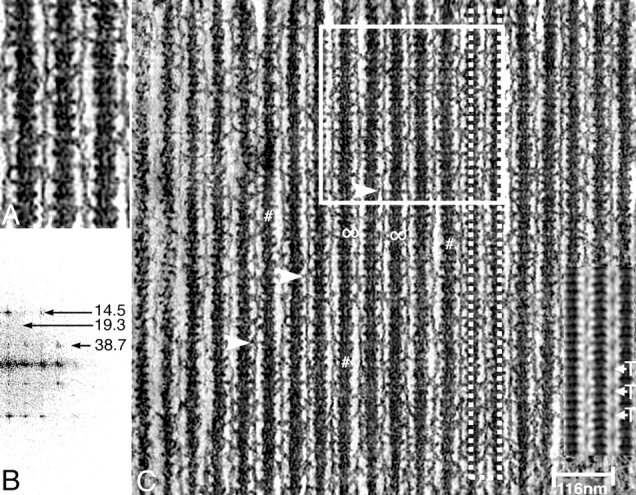
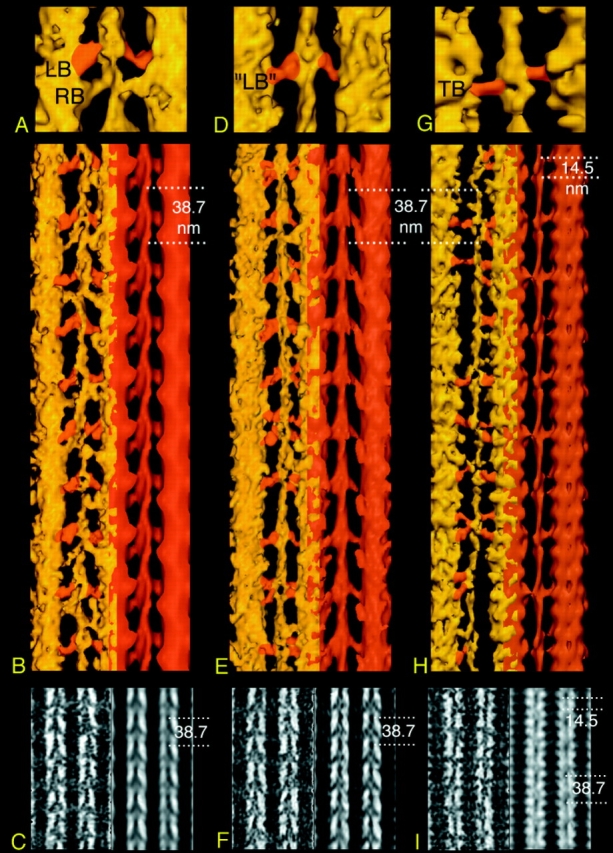
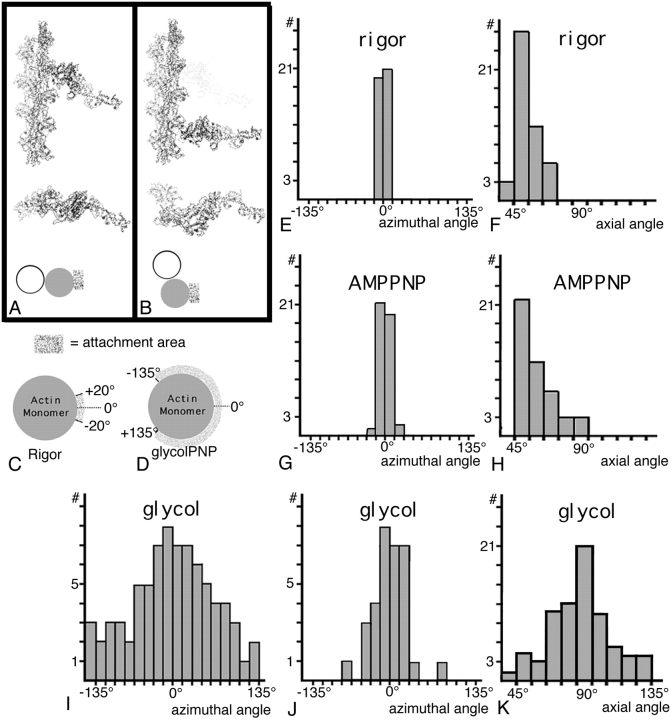
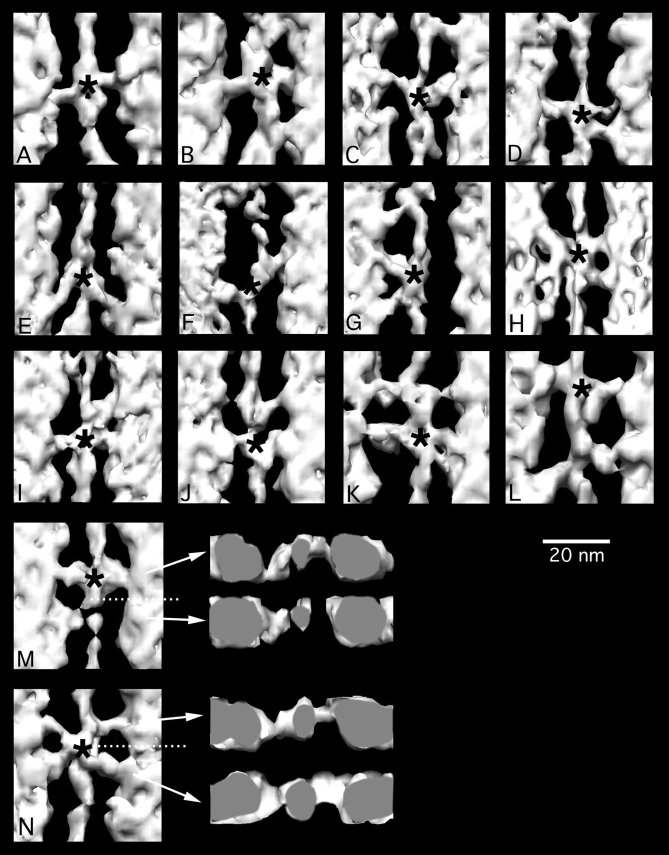
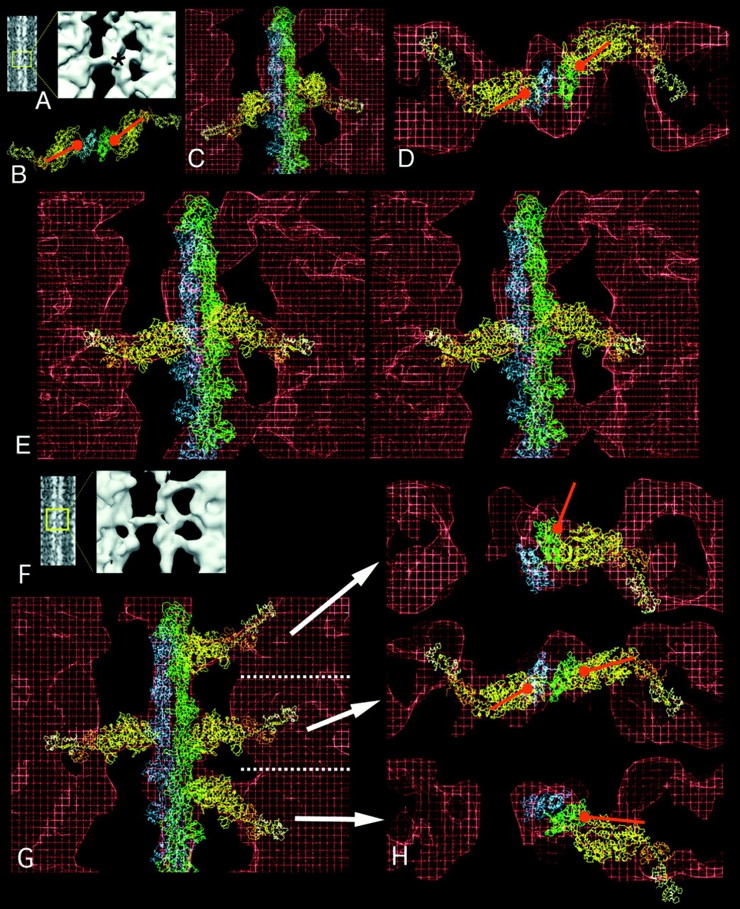
Rigor insect flight muscle (IFM) can be relaxed without ATP by increasing ethylene glycol concentration in the presence of adenosine 5'-[beta'gamma- imido]triphosphate (AMPPNP). Fibers poised at a critical glycol concentration retain rigor stiffness but support no sustained tension ("glycol-stiff state"). This suggests that many crossbridges are weakly attached to actin, possibly at the beginning of the power stroke. Unaveraged three-dimensional tomograms of "glycol-stiff" sarcomeres show crossbridges large enough to contain only a single myosin head, originating from dense collars every 14.5 nm. Crossbridges with an average 90 degrees axial angle contact actin midway between troponin subunits, which identifies the actin azimuth in each 38.7-nm period, in the same region as the actin target zone of the 45 degrees angled rigor lead bridges. These 90 degrees "target zone" bridges originate from the thick filament and approach actin at azimuthal angles similar to rigor lead bridges. Another class of glycol-PNP crossbridge binds outside the rigor actin target zone. These "nontarget zone" bridges display irregular forms and vary widely in axial and azimuthal attachment angles. Fitting the acto-myosin subfragment 1 atomic structure into the tomogram reveals that 90 degrees target zone bridges share with rigor a similar contact interface with actin, while nontarget crossbridges have variable contact interfaces. This suggests that target zone bridges interact specifically with actin, while nontarget zone bridges may not. Target zone bridges constitute only approximately 25% of the myosin heads, implying that both specific and nonspecific attachments contribute to the high stiffness. The 90 degrees target zone bridges may represent a preforce attachment that produces force by rotation of the motor domain over actin, possibly independent of the regulatory domain movements.
通过在5'-[β'γ-亚氨基]三磷酸腺苷(AMPPNP)存在的情况下增加乙二醇浓度,可使僵直昆虫飞行肌(IFM)在无ATP的情况下松弛。处于临界乙二醇浓度的纤维保持僵直硬度,但不支持持续张力(“乙二醇僵直状态”)。这表明许多横桥与肌动蛋白的附着较弱,可能处于动力冲程开始时。“乙二醇僵直”肌节的未平均三维断层扫描显示,横桥大到足以仅包含一个肌球蛋白头部,每隔14.5 nm起源于致密环。平均轴向角度为90度的横桥在肌钙蛋白亚基之间的中途接触肌动蛋白,这确定了每个38.7 nm周期中的肌动蛋白方位,与45度角的僵直引导桥的肌动蛋白靶区在同一区域。这些90度的“靶区”桥起源于粗肌丝,并以与僵直引导桥相似的方位角接近肌动蛋白。另一类乙二醇-PNP横桥结合在僵直肌动蛋白靶区之外。这些“非靶区”桥呈现不规则形状,轴向和方位附着角度变化很大。将肌动蛋白-肌球蛋白亚片段1的原子结构拟合到断层扫描中发现,90度靶区桥与僵直状态下与肌动蛋白具有相似的接触界面,而非靶区横桥具有可变的接触界面。这表明靶区桥与肌动蛋白特异性相互作用,而非靶区桥可能并非如此。靶区桥仅占肌球蛋白头部的约25%,这意味着特异性和非特异性附着都导致了高硬度。90度靶区桥可能代表一种预力附着,通过运动结构域在肌动蛋白上的旋转产生力,可能独立于调节结构域的运动。