Peng B, Tilby M J, English M W, Price L, Pearson A D, Boddy A V, Newell D R
Department of Oncology, Medical School, The University of Newcastle upon Tyne, UK.
Br J Cancer. 1997;76(11):1466-73. doi: 10.1038/bjc.1997.579.
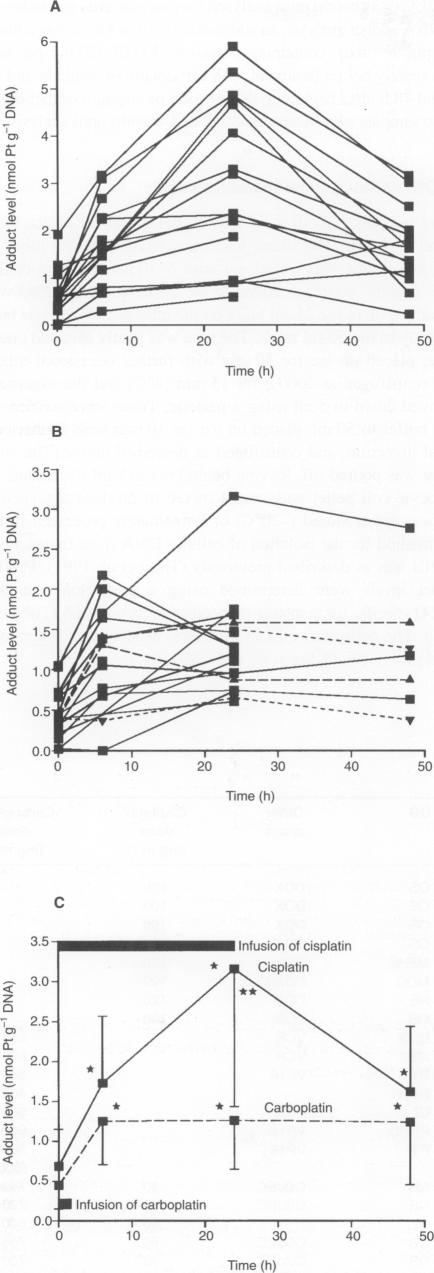
Platinum (Pt)-DNA adducts were measured in peripheral blood leucocytes (PBLs) from 24 children with solid tumours after standard cisplatin and/or carboplatin treatment. The relationship between Pt-DNA adduct levels and pharmacokinetics of cisplatin and carboplatin was investigated. Adduct measurements were performed by competitive enzyme-linked immunosorbent assay (ELISA) and plasma unbound Pt concentrations were measured by atomic absorption spectrophotometry (AAS). There was considerable interindividual variation in Pt-DNA adduct level that was weakly correlated (r2 = 0.32) with the area under the unbound drug concentration vs time curve (AUC) at 6 h after the start of cisplatin infusion, indicating that the variation in Pt-DNA adduct levels was primarily determined by factors other than AUC. No clear relationship between AUC and adduct levels was seen at 24 and 48 h after cisplatin or at 6, 24 or 48 h after carboplatin. Carboplatin produced lower levels of immunoreactive adducts than did cisplatin (1.3 +/- 0.6 nmol Pt g-1 DNA vs 3.2 +/- 1.7 nmol Pt g-1 DNA), despite a 20-fold higher unbound drug AUC for carboplatin (8.0 +/- 3.5 mg ml-1 min vs 0.4 +/- 0.2 mg ml-1 min). This study demonstrates that, after cisplatin and carboplatin treatment the drug-target interaction is determined by both pharmacokinetic and, predominantly, cellular factors. Intrinsic differences between the two complexes, primarily reactivity, probably explain the lower adduct levels observed after carboplatin treatment.
在24名接受标准顺铂和/或卡铂治疗的实体瘤儿童的外周血白细胞(PBL)中测量了铂(Pt)-DNA加合物。研究了Pt-DNA加合物水平与顺铂和卡铂药代动力学之间的关系。通过竞争性酶联免疫吸附测定(ELISA)进行加合物测量,并通过原子吸收分光光度法(AAS)测量血浆中未结合的Pt浓度。Pt-DNA加合物水平存在相当大的个体间差异,与顺铂输注开始后6小时未结合药物浓度-时间曲线下面积(AUC)呈弱相关(r2 = 0.32),这表明Pt-DNA加合物水平的差异主要由AUC以外的因素决定。在顺铂给药后24小时和48小时或卡铂给药后6小时、24小时或48小时,未观察到AUC与加合物水平之间有明确的关系。尽管卡铂的未结合药物AUC高20倍(8.0±3.5mg/ml·min对0.4±0.2mg/ml·min),但卡铂产生的免疫反应性加合物水平低于顺铂(1.3±0.6nmol Pt g-1 DNA对3.2±1.7nmol Pt g-1 DNA)。这项研究表明,顺铂和卡铂治疗后,药物-靶点相互作用由药代动力学和主要是细胞因素共同决定。两种复合物之间的内在差异,主要是反应性,可能解释了卡铂治疗后观察到的较低加合物水平。