White J G, Rao G H
Department of Laboratory Medicine and Pathology, University of Minnesota Medical School, Minneapolis 55455, USA.
Am J Pathol. 1998 Feb;152(2):597-609.
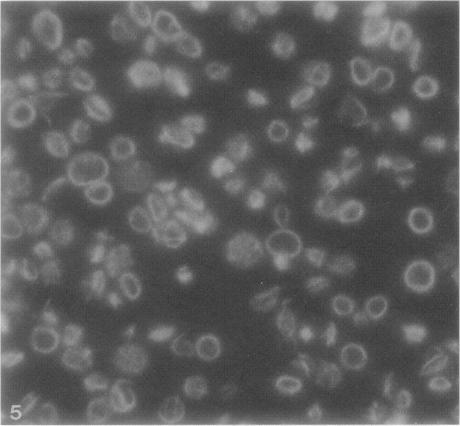
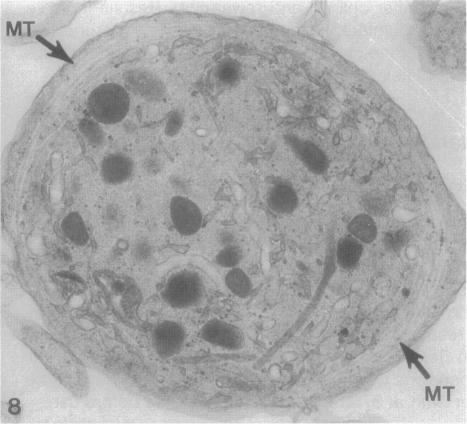
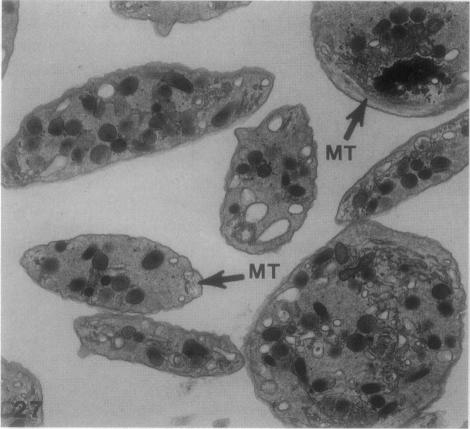
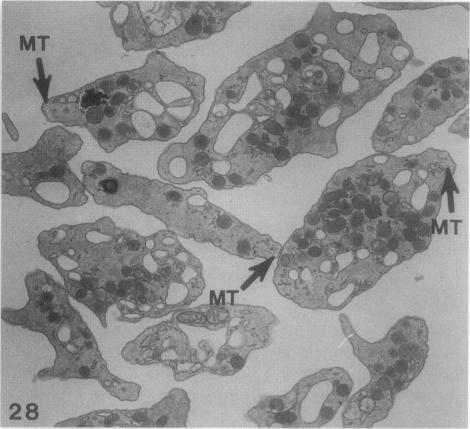
The discoid form of blood platelets is important to their function in hemostasis. Recent studies have suggested that the spectrin-rich surface membrane cytoskeleton and the cytoplasmic, actin-rich cytoskeleton are responsible for discoid shape, shape change, and recovery after activation or chilling. Earlier studies had suggested that circumferential coils of microtubules supported the disc shape of resting platelets and that their repositioning or reassembly restored disc shape after exposure to low temperature. The present study has used the chilling-rewarming model, together with microtubule stabilizing (taxol) and disassembling (vincristine) agents to retest the relative importance of the surface membrane cytoskeleton and circumferential microtubules in platelet discoid shape and its restoration. Washed platelet samples were rested at 37 degrees C and chilled to 4 degrees C; chilled and rewarmed to 37 degrees C for 60 minutes; or chilled, rewarmed, and exposed to the same cycle in the presence or absence of vincristine or taxol and fixed for study by disseminated interference phase contrast microscopy and electron microscopy. Rhodamine-phalloidin and flow cytometry were used to measure changes in actin filament assembly. Chilling caused loss of disc shape, pseudopod extension, disassembly of microtubule coils, and assembly of new actin filaments. Rewarming resulted in restoration of disc shape, pseudopod retraction, disassembly of new actin filaments, and reassembly of circumferential microtubule coils. Vincristine converted discoid platelets to rounded cells that extended pseudopods when chilled and retracted them when rewarmed, leaving spheres that could undergo the same sequence of changes when chilled and rewarmed again. Taxol prevented cold-induced disassembly of microtubules and limited pseudopod formation. Rewarming caused retraction of pseudopods on taxol-treated, discoid cells. Cytochalasin B, an agent that blocks new actin filament assembly, alone or in combination with taxol, inhibited the cold-induced shape change but not dilation of the open canalicular system. Rewarming eliminated open canalicular system dilation and restored lentiform appearance. The results indicate that microtubule coils are the major structural elements responsible for disc shape and its restoration after submaximal stimulation or rewarming of chilled platelets.
血小板的盘状形态对其在止血过程中的功能至关重要。最近的研究表明,富含血影蛋白的表面膜细胞骨架和富含肌动蛋白的细胞质细胞骨架负责盘状形态、形态变化以及激活或冷却后的恢复。早期研究曾表明,微管的圆周状螺旋支撑着静息血小板的盘状形态,并且在暴露于低温后它们的重新定位或重新组装恢复了盘状形态。本研究使用了冷却-复温模型,结合微管稳定剂(紫杉醇)和解聚剂(长春新碱),重新测试表面膜细胞骨架和圆周状微管在血小板盘状形态及其恢复中的相对重要性。洗涤后的血小板样本在37℃静置,然后冷却至4℃;冷却后再复温至37℃ 60分钟;或者在有或没有长春新碱或紫杉醇的情况下冷却、复温,并经历相同的循环,然后固定,通过散射干涉相差显微镜和电子显微镜进行研究。使用罗丹明-鬼笔环肽和流式细胞术来测量肌动蛋白丝组装的变化。冷却导致盘状形态丧失、伪足延伸、微管螺旋解聚以及新的肌动蛋白丝组装。复温导致盘状形态恢复、伪足回缩、新的肌动蛋白丝解聚以及圆周状微管螺旋重新组装。长春新碱将盘状血小板转变为圆形细胞,冷却时延伸伪足,复温时回缩伪足,留下的球体在再次冷却和复温时可经历相同的变化序列。紫杉醇可防止低温诱导的微管解聚并限制伪足形成。复温导致紫杉醇处理的盘状细胞上的伪足回缩。细胞松弛素B是一种阻断新的肌动蛋白丝组装的试剂,单独使用或与紫杉醇联合使用时,可抑制低温诱导的形态变化,但不能抑制开放小管系统的扩张。复温消除了开放小管系统的扩张并恢复了双凸透镜外观。结果表明,微管螺旋是负责盘状形态以及亚最大刺激或冷却血小板复温后其恢复的主要结构元件。