Suzhou Key Laboratory of Thrombosis and Vascular Diseases, State Key Laboratory of Radiation Medicine and Protection, Cyrus Tang Hematology Center, Collaborative Innovation Center of Hematology of Jiangsu Province, Soochow University, Suzhou, China.
The Institute of Neuroscience, Soochow University, Suzhou, China.
J Cell Mol Med. 2020 Apr;24(8):4773-4783. doi: 10.1111/jcmm.15151. Epub 2020 Mar 16.
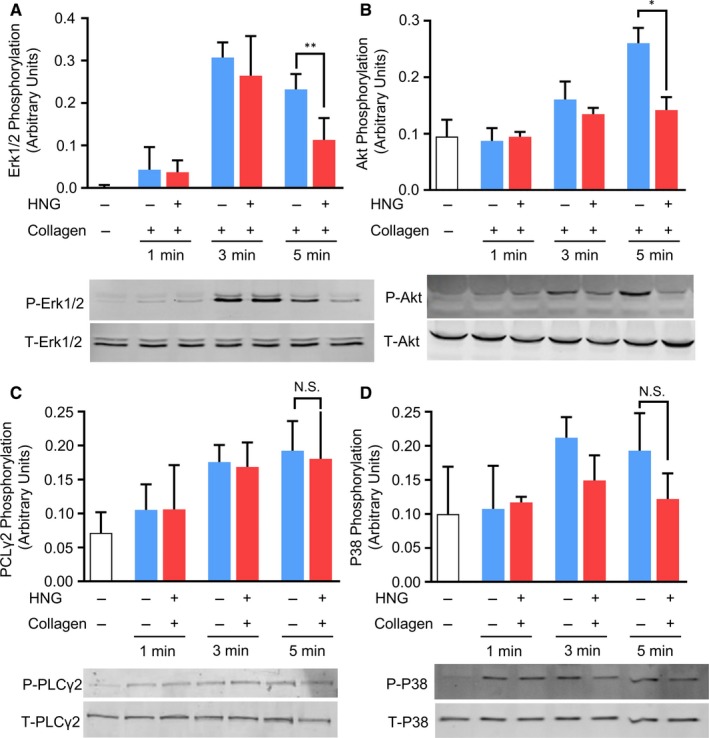
HNG, a highly potent mutant of the anti-Alzheimer peptide-humanin, has been shown to protect against ischaemia-reperfusion (I/R) injury. However, the underlying mechanism related to platelet activation remains unknown. We proposed that HNG has an effect on platelet function and thrombus formation. In this study, platelet aggregation, granule secretion, clot retraction, integrin activation and adhesion under flow conditions were evaluated. In mice receiving HNG or saline, cremaster arterial thrombus formation induced by laser injury, tail bleeding time and blood loss were recorded. Platelet microtubule depolymerization was evaluated using immunofluorescence staining. Results showed that HNG inhibited platelet aggregation, P-selectin expression, ATP release, and α β activation and adhesion under flow conditions. Mice receiving HNG had attenuated cremaster arterial thrombus formation, although the bleeding time was not prolonged. Moreover, HNG significantly inhibited microtubule depolymerization, enhanced tubulin acetylation in platelets stimulated by fibrinogen or microtubule depolymerization reagent, nocodazole, and inhibited AKT and ERK phosphorylation downstream of HDAC6 by collagen stimulation. Therefore, our results identified a novel role of HNG in platelet function and thrombus formation potentially through stabilizing platelet microtubules via tubulin acetylation. These findings suggest a potential benefit of HNG in the management of cardiovascular diseases.
HNG 是一种强效的抗阿尔茨海默病肽人源神经调节蛋白突变体,已被证明可预防缺血再灌注(I/R)损伤。然而,与血小板激活相关的潜在机制尚不清楚。我们提出 HNG 对血小板功能和血栓形成有影响。在这项研究中,评估了血小板聚集、颗粒分泌、凝块回缩、整合素激活和流动条件下的粘附。在接受 HNG 或生理盐水的小鼠中,记录了激光损伤诱导的提睾动脉血栓形成、尾出血时间和失血量。使用免疫荧光染色评估血小板微管解聚。结果表明,HNG 抑制血小板聚集、P-选择素表达、ATP 释放以及 αβ 在流动条件下的激活和粘附。接受 HNG 的小鼠提睾动脉血栓形成减弱,尽管出血时间没有延长。此外,HNG 还显著抑制微管解聚,增强纤维蛋白原或微管解聚剂诺考达唑刺激的血小板中微管的乙酰化,并抑制胶原刺激下游 HDAC6 的 AKT 和 ERK 磷酸化。因此,我们的研究结果确定了 HNG 在血小板功能和血栓形成中的新作用,可能是通过稳定微管蛋白乙酰化来稳定血小板微管。这些发现表明 HNG 在心血管疾病管理方面具有潜在益处。